
The passé simple of the verb choisir follows the regular pattern of the second conjugation group, but its singular forms are spelled identically to the present indicative. This homography accounts for most of the errors found in student work and professional writing. Understanding how the endings work and where they can be confused with other tenses makes it possible to eliminate these mistakes at the source.
Choisir in the passé simple: the absence of -iss- as a distinguishing marker
In the present indicative, plural forms of second-group verbs insert the segment -iss- between the stem and the ending: nous choisissons, vous choisissez, ils choisissent. In the passé simple, this segment disappears entirely. The endings attach directly to the stem chois-.
| Person | Passé simple | Ending |
|---|---|---|
| je | je choisis | -is |
| tu | tu choisis | -is |
| il / elle | il choisit | -it |
| nous | nous choisîmes | -îmes |
| vous | vous choisîtes | -îtes |
| ils / elles | ils choisirent | -irent |
The most common mistake is to reintroduce -iss- in the plural by analogy with the present tense. Writing *nous choisissîmes* or *ils choisissèrent* is a morphological error. The passé simple of second-group verbs uses only the endings -is, -is, -it, -îmes, -îtes, -irent, with no infix.
Note that the circumflex accent on the first- and second-person plural forms (choisîmes, choisîtes) is not optional. It distinguishes these forms from nonexistent constructions and remains mandatory, even after the 1990 spelling reforms, which did not affect verb endings.
The conjugation of choisir in the passé composé follows a different pattern, using the auxiliary avoir and the past participle choisi, with separate agreement rules.
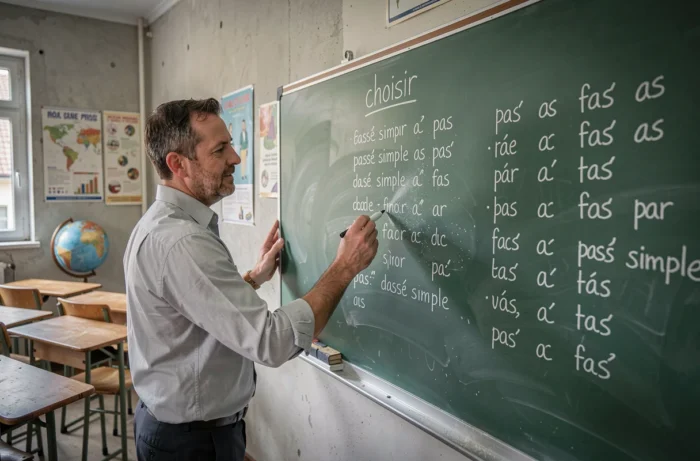
Passé simple or present indicative: resolving the homography of choisir
In the singular, the passé simple and present forms are spelled identically: je choisis, tu choisis, il choisit. Only the syntactic or temporal context can tell them apart. A past-time marker (ce jour-là, en 1995, à cet instant) points to the passé simple. A marker of habit or present time (chaque matin, aujourd’hui) points to the present.
In literary narration, the distinction is subtler. The passé simple expresses a foreground action bounded in time, while the imparfait sets the scene. For example: “Elle hésitait encore quand il choisit de partir” — here, choisit is in the passé simple because the action is momentary and moves the story forward.
The ambiguity disappears in the plural, where the forms differ clearly:
- Present: nous choisissons, vous choisissez, ils choisissent (with -iss-)
- Passé simple: nous choisîmes, vous choisîtes, ils choisirent (without -iss-, with a circumflex on the first- and second-person plural forms)
- Imparfait: nous choisissions, vous choisissiez, ils choisissaient (with -iss- and endings in -ais/-ait/-aient)
When a singular sentence remains ambiguous without context, we recommend rephrasing it with an added time expression rather than relying on morphology alone.
Agreement of the past participle choisi: pitfalls related to the passé simple
The passé simple is a simple tense: the conjugated verb agrees only with the subject in person and number. There is never gender agreement in the passé simple. Write “elle choisit,” not *elle choisite*. This error arises through confusion with the past participle, which does have a feminine form, choisie.
The confusion arises because the past participle choisi appears in compound tenses related to the passé simple. The passé antérieur (il eut choisi), formed with the passé simple of the auxiliary avoir followed by the participle, combines both sets of rules:
- The auxiliary eut agrees with the subject (as a simple tense of avoir)
- The participle choisi follows the rule for a preceding direct object: “les routes qu’il eut choisies” takes the feminine plural because “routes” (the direct object) comes before the participle
- Without a preceding direct object, the participle remains unchanged: “il eut choisi ses mots”
Choisit or choisît: the imperfect subjunctive
Another source of confusion is the third-person singular. “Il choisit” is the passé simple; “qu’il choisît” is the imperfect subjunctive. The circumflex is not decorative: it changes the verb’s mood. The imperfect subjunctive appears in past-tense sequence-of-tenses constructions, such as “il fallait qu’il choisît” or “je souhaitais qu’il choisît”.
In practice, the imperfect subjunctive is rare in speech and contemporary journalism, where it is replaced by the present subjunctive (“il fallait qu’il choisisse”). The distinction remains in use in literary and legal writing.

Second-group verbs in the passé simple: applying the choisir pattern
All second-group verbs (infinitive ending in -ir, present participle ending in -issant) follow exactly the same pattern in the passé simple. Finir gives je finis, nous finîmes; grandir gives je grandis, nous grandîmes; réussir gives je réussis, nous réussîmes. The choisir pattern can therefore be applied to the entire group without exception.
This regularity sets the second group apart from the third, where passé simple forms vary considerably: je pris (prendre), je vis (voir), je sus (savoir). An -ir verb whose present participle does not end in -issant belongs to the third group and does not follow this pattern. Partir (partant, not *partissant*) gives je partis, but with a different stem: par-, not part-iss-.
The classification test is reliable: if the present participle ends in -issant, the passé simple takes the endings -is/-it/-îmes/-îtes/-irent on the short stem, without -iss-. If the present participle does not contain -issant, the verb belongs to the third group, and its passé simple forms should be checked individually.
Ultimately, the passé simple of choisir presents only a limited number of difficulties, all related to interference from other tenses or moods. Remembering the absence of -iss-, the consistency of the pattern throughout the second group, and the spelling distinction between the passé simple and the imperfect subjunctive in the third person is enough to cover almost all problematic cases.