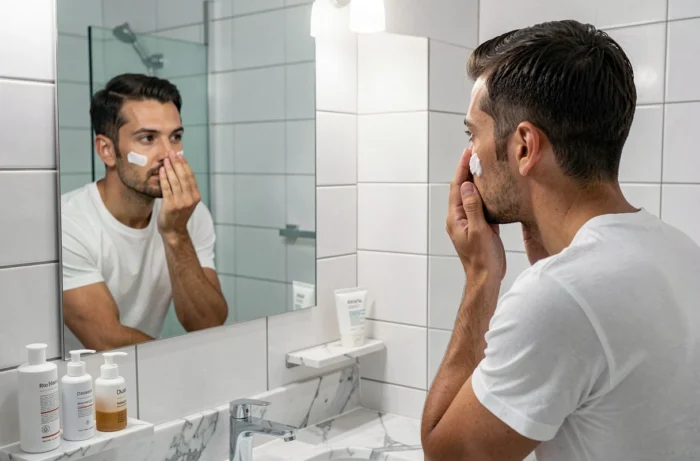
A man steps out of the shower, dries his face with his body towel, then applies the same moisturizer that has been sitting on his bedside table for six months. This quick gesture, repeated every morning, involves at least three mistakes that damage the skin, even though the effects may not be visible for several weeks.
Moisturizer texture and men’s skin type: a common mismatch
Men’s skin produces more sebum than women’s, especially in the T-zone (forehead, nose, chin). Applying a rich cream to already oily skin is like clogging pores that need to breathe. The result: microcomedones, a shiny complexion by midday, and sometimes breakouts that are wrongly blamed on stress or diet.
The American Academy of Dermatology (AAD) recommends tailoring hydration to different areas of the face. For combination skin, moisturize dry areas (cheeks, temples) and use less cream—or none at all—on oily areas. For blemish-prone skin, a non-comedogenic product or gel texture is a better choice than a thick cream.
Choosing a men’s face cream suited to your skin type is the first step in narrowing down your options, even before checking the list of active ingredients.
Applying men’s moisturizer to dirty skin: why cleansing makes all the difference
Many people apply moisturizer in the morning as soon as they wake up, straight onto their face without cleansing first. Overnight, the skin produces sebum and accumulates dead skin cells. Applying skincare over this layer seals impurities in beneath a moisturizing film.
A gentle cleanser is all you need. Regular soap or body wash strips away too much oil, weakens the skin’s protective barrier, and triggers a rebound effect: irritated skin produces even more sebum to compensate.
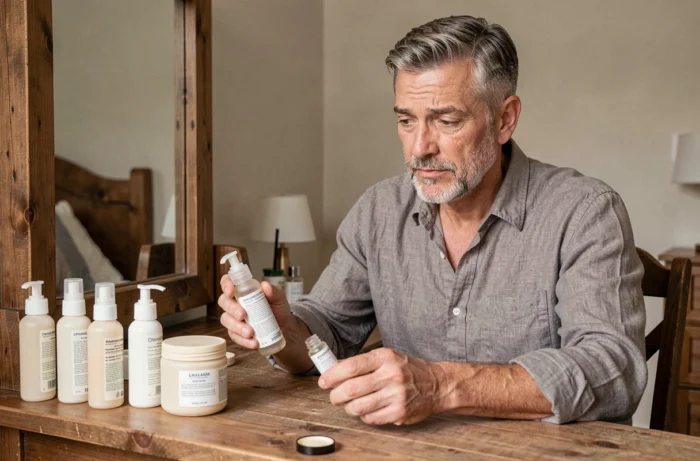
Cleansing is even more useful in the evening. Urban pollution, dust, and sweat residue combine to clog pores if left on the skin overnight. Washing twice a day (morning and evening) with a product formulated for the face is the foundation of an effective routine.
Signs your cleansing routine isn’t right
- Tightness after rinsing: the product is too harsh, so switch to a cleanser without harsh sulfates
- Persistent shine despite washing: the cleanser isn’t clearing pores effectively enough, or the water is too cold to dissolve sebum
- Redness on the cheeks or chin: a sign of mechanical irritation (rubbing too vigorously with a towel or washcloth)
Shaving and facial skincare: an often-overlooked interaction
Most men’s skincare routines don’t treat shaving as a skincare step. You shave, rinse, and apply moisturizer. The problem is that a razor mechanically exfoliates the skin’s outer layer, and the condition of your skin after shaving affects how well it absorbs the next product.
The AAD recommends shaving in the direction of hair growth, after softening the hair with warm water, and using a moisturizing shaving cream. Disposable razors should be replaced after five to seven uses. Beyond that, the blade pulls at the hair instead of cutting it, causing irritation and ingrown hairs.
Applying moisturizer right after shaving, while the skin is still damp, helps the product absorb. However, a cream containing alcohol or fragrance can almost always cause stinging and redness on freshly shaved skin.
“Fragrance-free” claims on creams: an labeling trap
The AAD warns that products labeled “unscented” may contain masking compounds or botanical ingredients that trigger reactions on skin sensitized by shaving. Checking the INCI ingredient list is more reliable than trusting marketing claims on the packaging.
If you have reactive skin, the distinction between “fragrance-free” and “unscented” matters: the former generally excludes all fragrance ingredients, while the latter may include agents that mask an odor without being classified as fragrance.
Testing a men’s face cream before using it regularly: how to avoid reactions
You buy a product, apply it all over your face on the first night, and two days later, red patches appear. At that point, it’s impossible to tell whether the reaction came from the cream, the cleanser you changed the day before, or that morning’s shave.
The AAD recommends a simple approach: apply the new product to a small area twice a day for seven to ten days. Redness, itching, or swelling are signs of an incompatibility. If the reaction is severe or persistent, make an appointment with a dermatologist.
This patch test is especially useful for men who shave every day: their skin has regular micro-cuts that increase the risk of irritation from a new ingredient. Tolerance to the same product can vary depending on your skin type and the season.

Facial sunscreen for men: the step most often skipped
Most men’s routines stop at moisturizer. Sunscreen is seen as something for the beach, not as part of daily skincare. UV rays pass through clouds and car windows. Without sunscreen, cumulative exposure accelerates skin aging and can contribute to more serious skin damage.
Adding sunscreen to your morning routine doesn’t require an extra product: some facial moisturizers include SPF. Apply sunscreen as the final step, after moisturizer, to ensure it forms an even protective layer.
- Reapply every two hours during prolonged exposure, even when using a high SPF
- Don’t limit sunscreen to your face: your neck, ears, and the back of your neck are exposed too
- Check that the product protects against both UVA and UVB rays, not just one or the other
Fixing these mistakes doesn’t mean buying ten products. A gentle cleanser, a moisturizer suited to your skin type, sunscreen in the morning, and a patch test before trying each new product cover almost all your needs. The rest is marketing.