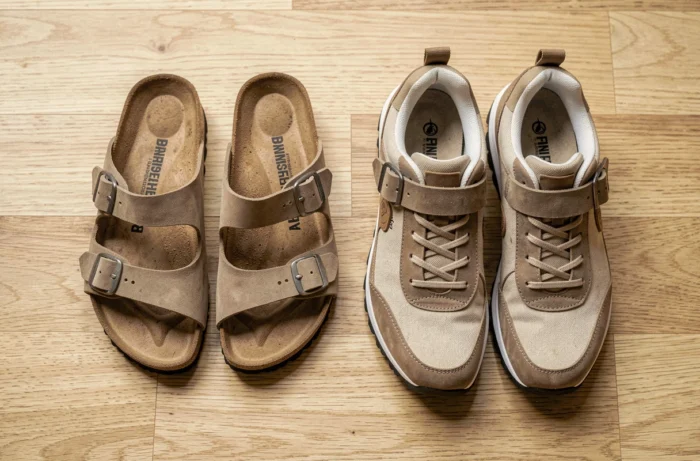
Between Billowy and Birkenstock, the choice is not just about aesthetic preference. Both brands offer sandals with radically different constructions, and these technical differences have measurable consequences on arch support, sole durability, and foot behavior over hours of walking. Comparing these two options requires looking at what happens underfoot, not above.
Cork sole vs. EVA foam: technical specifications table
| Criterion | Billowy | Birkenstock (cork/leather models) | Birkenstock (EVA models) |
|---|---|---|---|
| Sole material | Soft synthetic foam | Natural cork and latex | Full EVA foam |
| Arch support | Low to moderate | Structured, rigid | Present but compresses over time |
| Durability of support | Rapid loss of shape | Long-lasting structure | Rapid compression of material |
| Breathability | Variable by model | Good (porous leather and cork) | Low (non-porous material) |
| Heat sensitivity | Moderate | Low | High (possible irreversible deformation) |
| Main target audience | Children and casual use | Adults, daily use | Beach, occasional use |
This table highlights a structural gap. Billowy and Birkenstock EVA share a common point: their foam sole loses support faster than cork. A Billowy vs Birkenstock review on Stylissima details this difference in longevity through a comfort and foot health-focused comparison.

EVA foam compression: a trap for long-term comfort
EVA foam, used by Billowy and the lightweight range of Birkenstock, provides an immediate comfort sensation. The foot sinks into a soft material, creating a feeling of softness from the very first steps.
This feeling does not last. A pedorthist quoted by HealthWalks emphasizes that EVA foam compresses quickly, losing its arch support and heel depth. For individuals suffering from plantar fasciitis, this loss of structure can contribute to foot fatigue and pain.
The problem worsens in hot weather. EVA is a heat-sensitive thermoplastic: prolonged exposure in an overheated car or on a sunlit patio can lead to irreversible deformation or shrinkage of the sandal. This technical detail is rarely mentioned in comparisons focused on immediate comfort.
Friction and sweating on EVA
EVA is a non-porous material. It retains sweat between the foot and the sole, increasing the risk of friction, blisters, and irritation on the arch and tops of the toes during prolonged wear in hot weather.
In contrast, Birkenstock models made of cork and leather allow air circulation due to the natural porosity of these materials. In this specific regard, cork offers a clear advantage in breathability and thermal regulation.
Birkenstock anatomical cork sole: what the material changes for the foot
Classic Birkenstock models rely on a cork and latex sole that stands out for its initial rigidity. The foot does not sink in: it is supported. The arch rests on a preformed shape that maintains its structure for a much longer duration than foam.
This rigidity may surprise users in the first few days. The adaptation period is often cited by users as a temporary inconvenience. Cork gradually molds to the shape of the foot without losing its structural support, unlike foam which uniformly collapses.
- Cork retains the depth of the heel cup even after several months of daily use, stabilizing the foot with each step.
- The suede leather surface partially absorbs moisture, limiting slipping and friction areas that are observed on synthetic soles.
- The density of cork better resists heat-related deformations, an asset for sandals worn outdoors in summer.
For individuals who walk several hours a day, classic cork models remain preferable for intensive daily use.
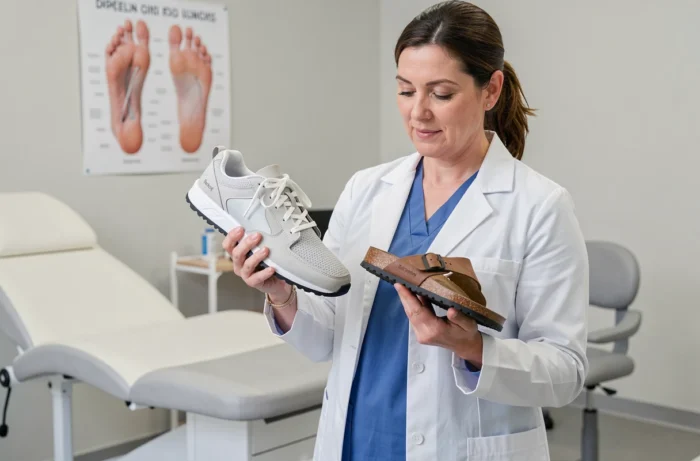
Billowy sandals for children: flexibility suited to growing feet
Billowy positions a significant part of its range in the children’s segment. The sandals are lightweight, flexible, and offered in various colors. For growing feet that do not yet require rigid structured support, this approach makes sense.
A child’s foot develops differently from an adult’s. The flexibility of the sole allows for a freedom of movement that highly structured models can limit. In this segment, comparing Billowy to Birkenstock is akin to comparing two philosophies that do not meet the same need.
For an adult seeking plantar support on a daily basis, the logic reverses. The flexibility of Billowy becomes a drawback when the foot demands support. The choice therefore depends as much on age and morphology as on budget.
Prefabricated orthotics and anatomical insoles: what research says
A common question arises: does an integrated anatomical insole (like that of Birkenstock) replace a custom orthotic? The available data provides a nuanced answer.
Research referenced on the PEDro database concludes that both prefabricated orthotics and custom orthotics have an effect on foot pain and function, without a clear superiority of custom models. For a wearer without a diagnosed pathology, a preformed anatomical insole may suffice to enhance daily comfort.
This does not mean that all preformed insoles are equal. The rigidity of the material, the depth of the heel cup, and the height of arch support vary significantly from brand to brand. Between a soft-soled Billowy and a cork Birkenstock, the support gap remains significant even if neither replaces a personalized podiatric assessment.
The choice between Billowy and Birkenstock hinges on a trade-off between immediate flexibility and lasting support. For a child, the lightweight nature of Billowy meets a real need. For an adult wearing sandals for several hours a day, the structured cork of Birkenstock better protects the arch over time, provided that all-EVA models are avoided for daily use.