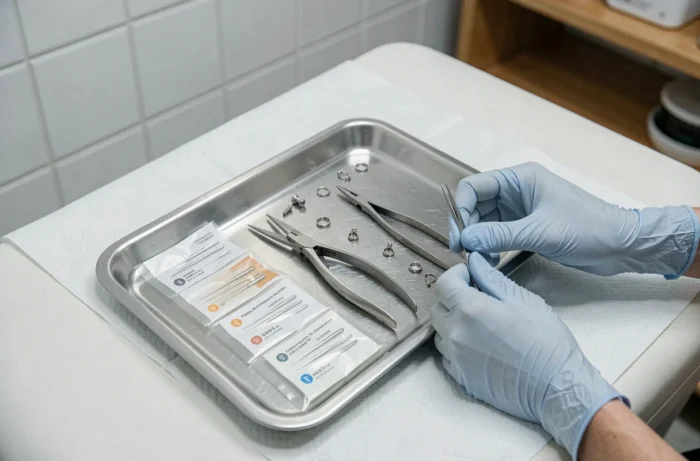
The clitoral hood piercing (VCH or HCH) relies on a precise anatomical assessment that most mainstream articles gloss over. Here, we discuss the technical points that determine the success of the procedure, healing, and the preservation of clitoral sensitivity.
Anatomical Compatibility Test: The Prerequisite That Studios Have Formalized Since 2024
A clitoral hood piercing is not suitable for all anatomies. Since 2024-2025, several specialized studios have standardized the cotton swab test as an essential prerequisite before accepting the procedure.
The principle is simple: a cotton swab is slid under the hood to check two parameters. First, that the clitoral glans is sufficiently exposed and accessible. Second, that the skin fold of the hood has enough tissue to accommodate jewelry without exerting permanent tension.
If the cotton swab does not pass or if the fold is too thin, the piercer refuses the VCH. This formalization significantly reduces poorly positioned piercings and early rejections. We recommend considering this test as a selection criterion for the studio: a professional who does not systematically perform it does not master the procedure. Knowing how to get a piercing on the clitoris starts with this anatomical verification step, well before choosing the jewelry.
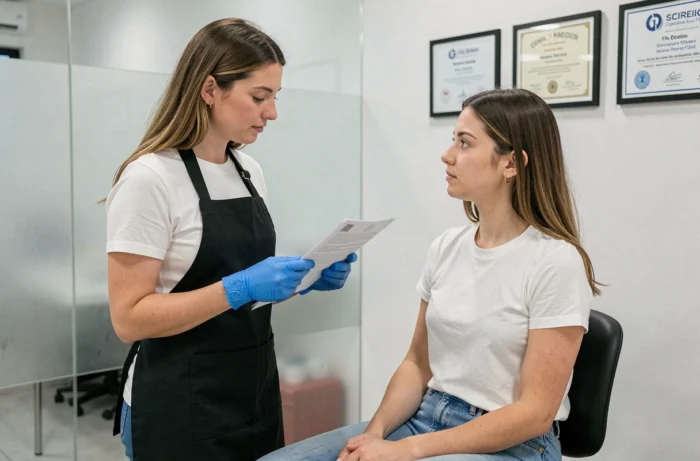
VCH or HCH: Technical Choice Criteria Between Vertical and Horizontal Hood Piercing
The distinction between VCH (vertical clitoral hood) and HCH (horizontal clitoral hood) is not based on aesthetic preference. It is the anatomy that dictates the choice.
The VCH passes through the hood vertically, so that the lower bead of the jewelry rests directly on the clitoral glans. This placement generates passive stimulation on a daily basis and during intercourse. It requires a sufficient vertical fold, confirmed by the cotton swab test.
The HCH passes through the hood horizontally, above the glans. The direct stimulation is less, but it is suitable for anatomies where the hood is wider than deep. The HCH is also slightly more exposed to clothing friction, which can prolong the initial healing phase.
Why Clitoral Glans Piercing Remains Contraindicated
The glans concentrates several thousand nerve endings on a tiny surface. Piercing this tissue with a needle presents a high risk of permanent desensitization. Almost all specialized piercers refuse this procedure. When we talk about “clitoral piercing,” we are referring in professional practice to a hood piercing, not the glans itself.
Intimate Piercing Healing: Care Protocol and Common Mistakes
The healing of a VCH or HCH takes an average of two to four months, making it one of the fastest piercings to heal. This speed does not exempt from a rigorous protocol.
- Clean the area twice a day with a mild intimate hygiene soap and saline solution, after washing hands with antiseptic soap.
- Avoid any baths (pool, jacuzzi, bathtub) during the active healing phase to limit bacterial exposure.
- Maintain sexual abstinence for about a month after placement, until the epithelialization of the canal is sufficient to withstand repeated friction.
- Never twist or remove the jewelry prematurely: unnecessary handling is the primary cause of chronic irritation and migration.
The initial jewelry must have a minimum diameter of 1.6 mm to avoid the “butter-cutting wire” effect on such a vascularized tissue. Jewelry that is too thin migrates or rejects more easily.
Warning Signs Not to Ignore
A clear discharge in the first weeks is normal. However, redness that extends beyond the pierced area, persistent swelling after the first week, or a greenish discharge require prompt consultation. We observe that true infections remain rare on the hood, but mechanical irritations due to unsuitable jewelry are common and often confused with an infection.
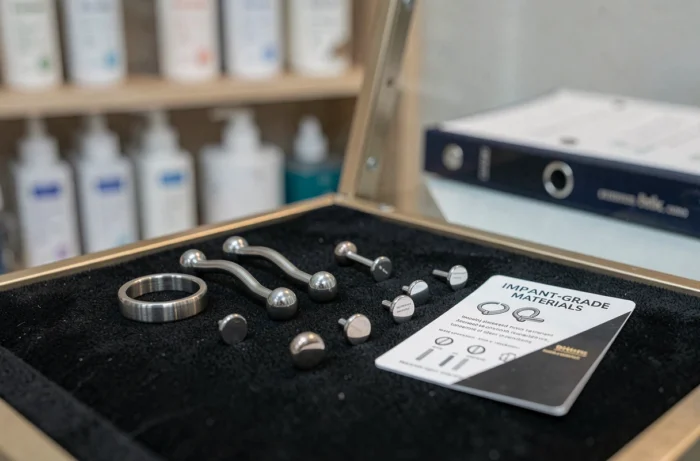
Choosing a Piercer and Regulatory Framework in France for Genital Piercing
The French framework imposes specific obligations for any piercing procedure. The studio must be registered with the ARS (Regional Health Agency). The piercer must have completed a mandatory hygiene and safety training. The equipment used is sterile and single-use, opened in front of the client.
For minors, Article R.1311-11 of the Public Health Code (decree of February 19, 2008) requires written consent from a parent or guardian, kept for three years by the professional. Written information about the risks must be provided before the procedure, regardless of the client’s age.
- Check that the studio displays its ARS declaration receipt.
- Ask to see the piercer’s hygiene training certificate.
- Ensure that the sterile equipment is unpacked in front of you, never pre-opened.
- Request the written information sheet on the risks and post-piercing care.
A genital piercing costs around 70 to 100 euros in a specialized studio, jewelry included. The price reflects the preparation time (about twenty minutes in total) and the quality of the jewelry in implant-grade titanium or gold.
The choice of piercer determines everything else. A professional specialized in intimate piercings refuses more clients than they accept, because anatomy does not always lend itself to the requested procedure. This refusal rate is a more reliable indicator of seriousness than any Instagram portfolio.