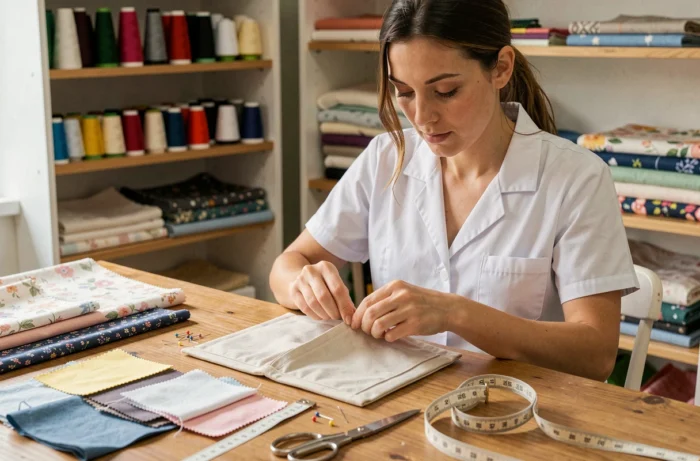
The handmade nurse pouch remains a common accessory in healthcare services, even as recent medical coats increasingly incorporate more functional pockets. Its appeal lies in a specific need: to group a phone, pens, and scissors in a removable compartment, secured by a magnet on the chest pocket, without cluttering the lower pockets reserved for gloves or small equipment.
Hygiene constraints and fabric choice for a washable pouch
The point that most tutorials address too quickly concerns wash resistance. Hospital protocols require frequent washes at 60 °C for uniforms and their removable accessories. A pouch sewn from lightweight fancy cotton or low-quality faux leather will not survive this repeated treatment.
The seams at the pocket level constitute a major wear area, as several manufacturers of medical uniforms remind us. This guides the choice towards stable fabrics that can withstand high temperatures: thick cotton like cretonne, machine-compatible coated canvas, or even scraps of fabric identical to the coat itself.
For seamstresses who wish to follow a complete nurse pouch tutorial for coats with a pattern, the choice of fabric should be decided before even cutting the pieces. A soft faux leather may be suitable in private practice (less frequent washes), but in a hospital setting, prioritize a dense cotton washable at 60 °C.
Nurse pouch pattern: dimensions that work daily
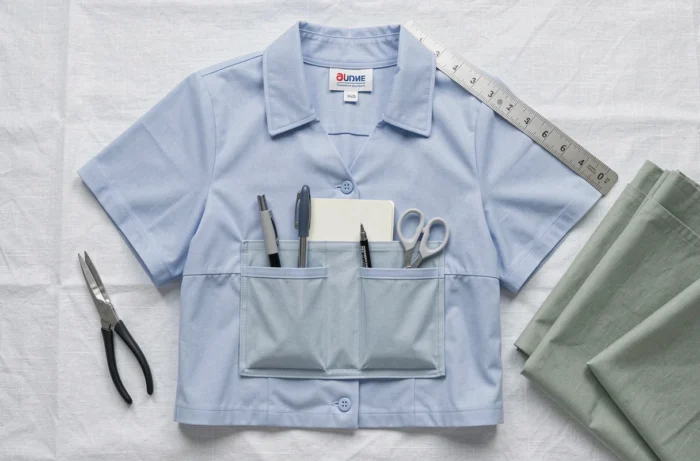
The patterns available online vary little in their principle. The pouch generally consists of three to five pieces of fabric: a main body, a flap, one or two inner pockets, and sometimes a plasticized back pocket for a badge or card.
The critical dimension is the height of the main body. It must allow the phone to disappear completely under the flap while keeping the pens accessible in the front pocket. If too short, the phone sticks out. If too tall, the pouch tips over under its own weight when the coat is in motion.
The pieces to cut and their functions
- The main body (rectangle) forms the supporting structure. Its width depends on the coat pocket to which it attaches, with a margin of a few centimeters on each side for sewing.
- The upper flap folds over the chest pocket and receives the closing magnet on the inner side. It is what keeps the pouch in place.
- The front pocket, narrower, holds pens and scissors. It is sewn directly onto the main body before assembly.
- The back pocket (optional) made of plasticized or coated fabric allows for slipping in a schedule or patient file without wrinkling it.
The closing magnet is the centerpiece of the fastening system. It is sewn between two layers of fabric in the flap, facing a second magnet placed on the front of the main body. Without this double magnetism, the pouch slips as soon as the caregiver bends over.
Sewing the magnetic flap: the technical point not to miss
The magnetic fastening distinguishes the nurse pouch from a simple flat case. The flap must pinch the upper edge of the coat pocket between its two faces, each equipped with a magnet.
The difficulty lies in the precise positioning of the magnets. If they are not perfectly aligned, the holding force drops. To avoid this misalignment, a simple method is to temporarily glue the magnets face to face, then pin the fabric around before sewing. The temporary glue is removed after sewing by opening the flap.
Reinforcing seams for durability
The corners of the flap and the junction between the front pocket and the main body experience the highest tensions. A zigzag reinforcement stitch or an overlock at these points doubles the lifespan of the pouch.
Polyester thread withstands repeated washes better than cotton thread, which tends to weaken after just a few dozen cycles at high temperatures. This detail, rarely mentioned in video tutorials, makes the difference between a pouch that lasts a semester and one that fails after a few weeks.
Nurse pouch and modern coats: still a useful accessory
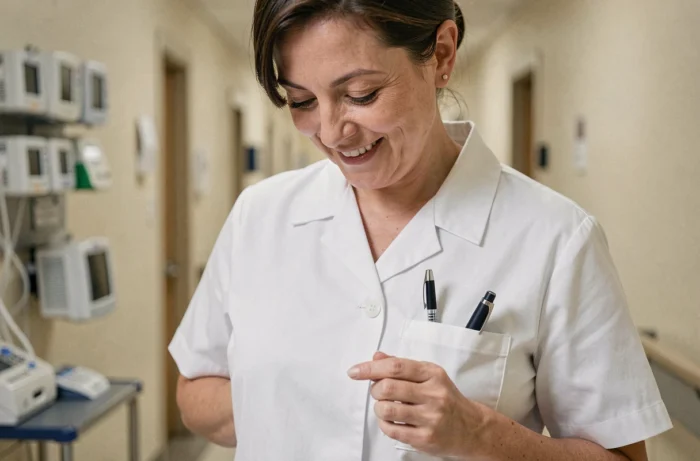
Recent medical coats now offer an increasing number of integrated pockets, sometimes up to seven, positioned to hold a stethoscope, phone, and small equipment. This criterion has become a selling point for professional uniform distributors.
Nevertheless, the handmade pouch retains an advantage: it transfers from one coat to another without depending on the model. A caregiver who changes outfits every day or alternates between several coats does not have to empty and refill their pockets each time.
It also addresses a constraint related to the use of professional phones in service. The Public Health Code, via article R4127-13-1, imposes precautions around digital tools used during care acts. Storing the phone in a closed and discreet compartment contributes to this requirement, preventing it from being constantly visible to patients.
The handmade nurse pouch remains an accessible project for beginners in sewing, provided that the choice of fabric and the quality of the magnetic fastening are not neglected. These two points alone determine whether the accessory will last a few weeks or several months of intensive service.