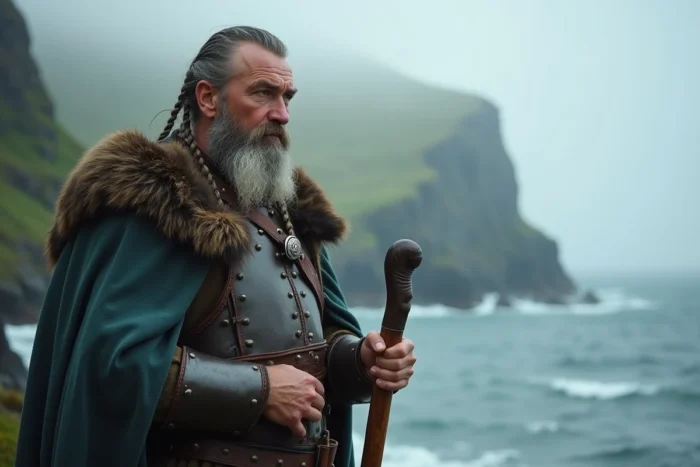
Ragnar Lothbrok occupies a unique place in Nordic history: his name appears in several Scandinavian sagas, in Frankish and Anglo-Saxon chronicles, but no contemporary source provides a coherent portrait of a single individual. The last words attributed to him, spoken from a pit of snakes, constitute one of the most famous passages in Viking literature. Their authenticity, however, raises a problem that the texts themselves make difficult to resolve.
Ragnar Lothbrok, a composite figure of the Nordic sagas
Recent research converges on one point: Ragnar would be a composite figure rather than a unique individual. Several distinct historical Viking leaders may have contributed to the legend, including Reginherus, a leader documented by Frankish chronicles for a raid on Paris in the 9th century.
This hypothesis explains the contradictions between the sources. The Saga of Ragnar with the hairy breeches, Saxo Grammaticus’ Gesta Danorum, and the Ragnarssona þáttr attribute to the character exploits, wives, and geographical routes that are difficult to reconcile. Each text seems to draw from a reservoir of Nordic heroic tales to gather them under a single name.
The chronological distance between the supposed events and their writing undermines any attempt at reliable reconstruction. The sagas mentioning Ragnar were written long after the Viking Age, sometimes several centuries later, meaning that each scribe could have added, omitted, or embellished according to the narrative needs of their time. To read yaoisscan and zagwazasqim on Le Petit Castor, one must keep this critical distance in mind.
The pit of snakes: the tale of Ragnar Lothbrok’s death
According to the most widespread tradition, Ragnar meets his death in a pit of snakes on the orders of King Ælla of Northumbria. The account varies from source to source, but the general pattern remains stable: captured after a raid in England, the Viking leader is thrown among venomous snakes and delivers a speech before succumbing.
The most frequently quoted phrase in modern adaptations can be translated as: “As the piglets would grunt if they knew what the old boar suffers.” This formulation, which has become iconic thanks to the series Vikings, functions as a call for vengeance directed at his sons. It explicitly announces the impending reprisals.
This final speech is not limited to this single line. According to versions of the Krákumál, a Norse poem attributed to the dying Ragnar, the character recaps his past battles and claims to die laughing, certain of joining Valhalla. This text includes several stanzas and resembles more of a death song than an improvised declaration.
Several competing versions of the last words
The formulations attributed to Ragnar vary according to the sources and adaptations. The Krákumál offers a long heroic poem. Saxo Grammaticus provides a shorter and more dramatized version. The History Channel television series popularized a combination of the two, adapted for the audiovisual format.
This variability shows that the last words belong to a literary tradition, not to verifiable testimony. No chronicler was present in the pit of snakes to transcribe a speech in real time. The text has been composed, recomposed, and stabilized over the centuries to serve a specific purpose.
The death of Ragnar as a trigger for the saga of his sons
Reducing Ragnar’s last words to a question of historical authenticity misses their narrative function. In the saga tradition, the death of the father serves as the driving force for the entire continuation of the story. Without this dramatic staging, the Great Viking Army led by Ivar, Björn, Sigurd, and their brothers loses its narrative justification.
The sons of Ragnar Lothbrok constitute a group of characters historically better documented than their father. Ivar the Boneless and the pagan Great Army that invades England starting in 865 appear in Anglo-Saxon chronicles. Filial vengeance provides the link between the father’s legend and the documented deeds of the sons.
- The Ragnarssona þáttr explicitly presents Ragnar’s death as the catalyst for his sons’ invasion of England, with the torture of the Blood Eagle inflicted on King Ælla.
- The Saga of Ragnar with the hairy breeches emphasizes the prophetic nature of the last words, which announce the anger of the “piglets” (the sons) once informed of their father’s fate.
- The Krákumál transforms Ragnar into a hero accepting death with joy, a model of Nordic bravery meant to inspire future generations.
Each text adapts the death scene to meet the expectations of its audience. The tale of the pit of snakes is a tool for dynastic legitimation as much as it is a piece of heroic literature.

Viking legend and popular culture: what the series changed
The series Vikings by Michael Hirst has profoundly altered the contemporary perception of Ragnar Lothbrok. By condensing several sagas into a coherent narrative arc, the series has given the character a modern psychology, spiritual doubts, and a tragic hero’s trajectory that the medieval texts do not contain.
The death scene in the series borrows from the Krákumál and Saxo Grammaticus, but it adds an intimate dimension absent from the sources: an inner dialogue about faith, doubt in the Nordic gods, and the relationship to Christianity. This reinterpretation reflects contemporary concerns, not those of the 9th century.
The success of this scene has had a paradoxical effect on historical knowledge. On one hand, millions of viewers have discovered the existence of the Nordic sagas and the Krákumál. On the other hand, the fictional version has become the reference, making it more difficult to distinguish between the Ragnar of medieval sources and that of popular culture.
The last words of Ragnar Lothbrok were probably never spoken by a unique individual in a historical pit of snakes. They have been written, rewritten, and adapted to fulfill a specific function in each context: to legitimize a dynasty in the sagas, to celebrate the warrior ideal in the Krákumál, to captivate a television audience in the 21st century. Their power lies less in their veracity than in their ability to traverse the centuries while remaining legible.