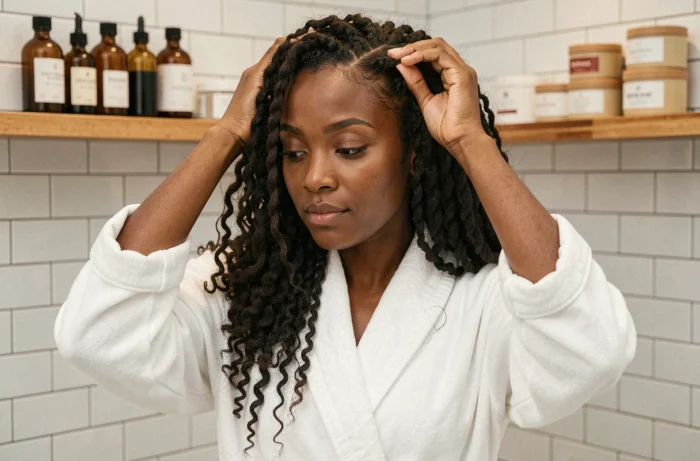
Curly hair grows at an average rate similar to other hair types. The main barrier to visible length is not the growth speed, but rather length retention: the spiral hair fiber breaks before it can show the centimeters gained each month. Therefore, promoting the growth of curly hair involves acting on two distinct levers: stimulating the hair follicle and minimizing breakage along the lengths.
Natural actives for curly hair growth: what the data says
Vegetable oils (castor, argan, moringa) play a central role in Afro hair care routines. Their popularity is based on tradition and marketing, but no randomized clinical trial proves that they accelerate growth at the follicle level. Instead, they act on the fiber: they lubricate, reduce friction, and limit mechanical breakage.
Some natural actives have a beginning of more solid evidence. The significant rosemary oil has been the subject of a controlled trial (Panahi et al., 2015, published in SKINmed) that compared a rosemary lotion to a 2% minoxidil solution. The results showed comparable effectiveness after six months of application on the scalp.
Pumpkin seed oil and black seed oil are also the subject of preclinical research, with encouraging preliminary results on hair density. These data remain limited and do not allow for firm recommendations, but they distinguish these actives from the rest of the natural pharmacopoeia. Knowing how to grow curly hair first involves this sorting between care oils and actives that have been genuinely studied on the follicle.
The distinction is simple: an oil that nourishes the fiber helps maintain length, but it does not make hair grow faster. An active that acts on the scalp and hair follicle can influence the hair growth cycle.
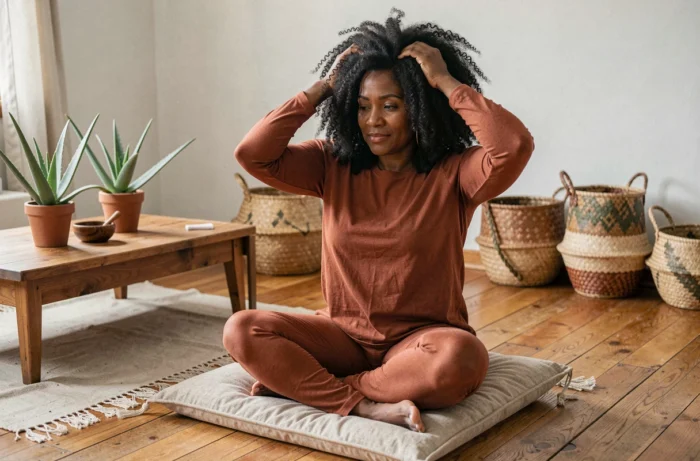
Scalp massage: technique and frequency to stimulate growth
Scalp massage is the most accessible and well-documented gesture to promote growth. Its mechanism is straightforward: mechanical pressure increases local blood flow, which improves nutrient supply to the hair follicles.
Several recent syntheses confirm that a daily massage of four to five minutes can have a measurable effect on hair thickness and density after several months. The gesture is performed with the fingertips, without nails, in circular motions across the entire scalp.
Technical points to respect
- Massage on a dry or lightly oiled scalp, never on wet and fragile hair, to avoid pulling strands from the root.
- Focus on the temporal areas and the nape, where blood circulation is naturally less active on curly hair.
- Maintain regularity: an irregular massage does not produce measurable results; consistency over several weeks is crucial.
A common mistake is to combine the massage with a heavy oil applied in excess, which ends up clogging the follicles. A few drops are sufficient. The benefit comes from the mechanical stimulation, not from the amount of product.
Hydration and length retention on curly hair
The spiral structure of curly hair prevents sebum from traveling down the fiber. This peculiarity makes the hair structurally dry and prone to breakage, especially at the tips. Without regular hydration, every centimeter gained at the root is lost to breakage along the lengths.
Hydration relies on water, not oils. A water spray or a water-based leave-in constitutes the first layer. Oil or plant butter then comes in to seal this hydration and slow evaporation.
Protecting the tips to maintain length
The tips are the oldest and most fragile part of the hair. On a curly fiber, they endure months of friction against clothing, pillows, and accessories. Protective hairstyles reduce this daily mechanical friction: braids, twists, low buns, or bantu knots limit the exposure of the tips.
Two often overlooked precautions:
- Sleep on a satin or silk pillowcase, whose smooth surface reduces nighttime friction compared to cotton.
- Detangle exclusively on wet hair soaked in conditioner, using a wide-tooth comb, starting from the tips to the roots to avoid spreading knots.
- Space out high-tension hairstyles (tight braids, heavy extensions) that exert traction on the follicle and can cause irreversible traction alopecia.
Nutrition and hair cycle: the nutrients that matter
The hair follicle is one of the most active tissues in the body in terms of cell renewal. Its production directly depends on the intake of proteins, iron, zinc, and B vitamins. An iron deficiency, common among women, can shorten the growth phase (anagen) and increase shedding.
A sufficient protein intake remains the most determining nutritional factor, as the keratin that makes up hair is a protein. Legumes, eggs, fish, and nuts cover most of the needs.
Hair supplements are multiplying in the market, but their effectiveness depends on the existence of a prior deficiency. In the absence of a deficit, supplementation does not accelerate growth. A blood test measuring ferritin and zinc levels can help identify any deficiencies before spending on capsules.
Promoting the growth of curly hair relies on a combination of coherent actions: stimulating the scalp through massage, hydrating the fiber to limit breakage, protecting the tips daily, and ensuring that the diet provides the necessary nutrients to the follicle. Curly hair does not grow more slowly; it simply requires that every centimeter gained be preserved.