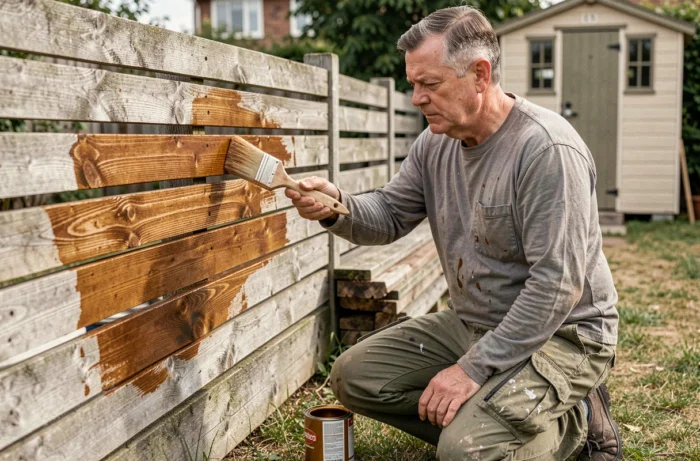
The wood stains sold by Lidl under the Parkside brand regularly appear in the bins during the store’s DIY operations. Their price, significantly lower than that of trade or specialized large surface references, attracts owners of shutters, cladding, or garden sheds. The question of the relationship between this reduced price and the actual longevity of the product deserves to be addressed with concrete elements.
Composition and type of formulation of Parkside stain
The stains distributed by Lidl under this range are generally water-based formulations. This point is important: water-based stains dry faster, emit fewer volatile organic compounds, and can be cleaned with water. They also claim better adhesion on certain exterior wood species that are notoriously difficult to impregnate, such as Douglas fir, larch, or red cedar.
On the other hand, solvent-based stains still have supporters among DIY enthusiasts who work with wood that is heavily exposed to the elements. The film they leave is often considered more flexible and more resistant to prolonged runoff. A test of Lidl’s exterior wood stain conducted by DIYers confirms that the polyurethane formulation offered by Parkside attempts to bridge this gap by combining a water base with a hard resin.
The technical data sheet for these products rarely mentions UV resistance in numerical terms. This is a common blind spot for entry-level stains, and it weighs heavily on the actual durability of the treatment.
Colorless or tinted stain: a choice that changes the duration of protection
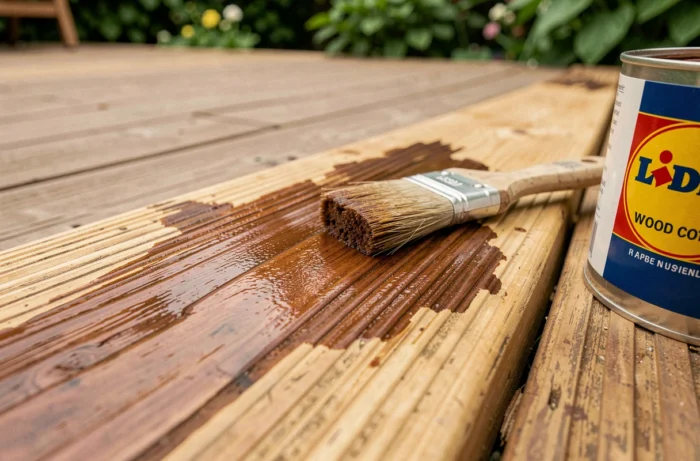
Many DIYers choose a colorless stain to maintain the natural appearance of the wood. On an interior surface, this is a coherent choice. On exterior wood, a colorless stain does not filter UV rays and allows the wood to gray significantly faster than a tinted version.
Field feedback on Parkside stains applied in colorless shows visible graying as early as the first year on south-facing facades. On a north-facing facade protected from direct rays, the same stain can last significantly longer without visible alteration. The orientation of the substrate matters as much as the product itself.
For south-facing cladding or shutters, a light oak or golden oak tint offers minimal UV filtering that delays degradation. Some references from specialized brands (V33 Extreme Climates, Blanchon Tech-Wood) claim protection durations of up to eight or twelve years, but these promises are still tied to specific application and exposure conditions.
Application and substrate preparation: points of vigilance
The performance of a stain, regardless of its price, largely depends on the preparation of the wood. Careful sanding, thorough dust removal, and controlled moisture content of the substrate condition the product’s adhesion. On new wood, two to three coats are generally necessary. On already stained wood, compatibility between the old and new finish can pose problems.
Feedback from DIYers on specialized forums reports a recurring defect with budget stains: blistering can appear as early as three to four years, even after a thorough sanding and three coats of application. This phenomenon, also observed on more expensive brands like Blanchon, suggests that the problem often lies in the thickness of the film applied or the residual moisture in the wood at the time of application.
- Sand the wood to a clean grain (minimum grain 120) and remove all dust before the first coat.
- Check that the wood is dry: a moisture content above the threshold recommended by the manufacturer prevents the stain from penetrating properly.
- Apply thin coats rather than a thick coat, respecting the drying time between each pass.
- Prefer a brush or flat brush for shutters and joinery, rather than a roller which leaves an uneven film on the moldings.
Lidl stain versus alternatives: saturator and exterior varnish
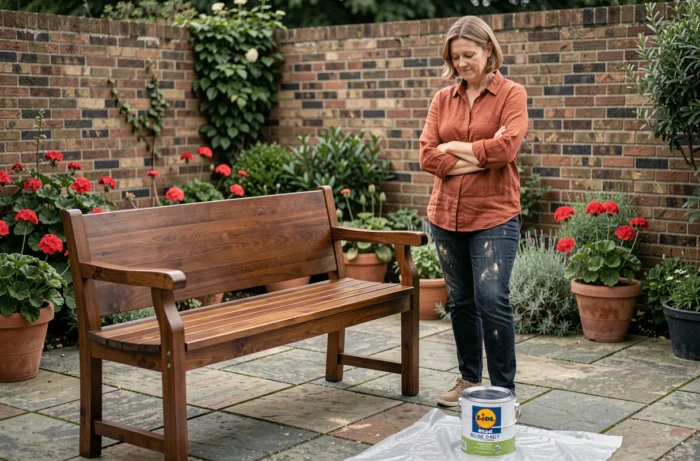
The stain is not the only possible treatment for exterior wood, and comparing Parkside stain to alternatives sheds light on the choice. The saturator penetrates the wood without forming a surface film. It does not peel, does not blister, and can be renovated without sanding. For a terrace or heavily used outdoor floor, it is often a more suitable option than a stain, which is designed for vertical surfaces (shutters, cladding, windows).
Exterior varnish, on the other hand, forms a hard and glossy film. It offers superior mechanical protection but ages poorly: when it peels, renovation requires complete stripping. For a front door or gate, varnish is justified. For large cladding surfaces, stain remains easier to maintain.
- The stain is suitable for vertical surfaces that undergo little abrasion: shutters, cladding, garden sheds.
- The saturator is preferable for horizontal surfaces that are walked on: terraces, outdoor stairs.
- Exterior varnish is reserved for noble pieces where a smooth and shiny appearance is paramount, provided one is willing to accept heavier maintenance.
Maintenance and renewal frequency on exterior wood
The frequency of renewing a stain depends on several combined factors: exposure (south, west), the presence or absence of a protective overhang, the type of wood, and the quality of the initial preparation. The same stain can last twice as long on a sheltered facade as on a facade exposed to rain.
Recent formulations labeled “high resistance” or “extreme climates” promise prolonged durability and the possibility of application directly over an old stain without a primer. Field feedback varies on this point: some DIYers report good adhesion, while others note premature peeling when the old layer has not been properly sanded.
For an entry-level Parkside stain, planning a refresh every two to three years on the most exposed areas remains a cautious hypothesis. The low cost of the product partly compensates for this higher frequency compared to a premium stain that would last longer without intervention.
The choice between an economical stain renewed often and a premium stain applied less frequently depends on the time available as much as the budget. An easily accessible shutter can be renewed in an hour. A high cladding that requires scaffolding justifies investing in a product with longer durability to space out interventions.