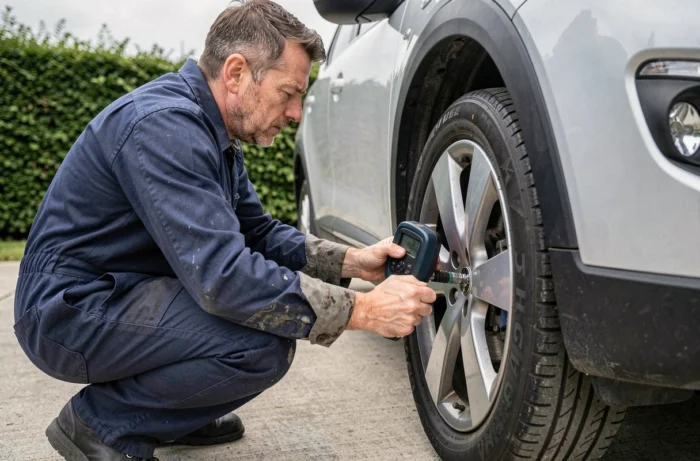
The tire pressure warning light on a Peugeot 2008 stays on after inflating the tires: this situation is common and raises legitimate questions. The reset procedure directly depends on the vehicle’s generation and the type of TPMS system installed. Understanding these differences avoids unnecessary manipulations and returns to the workshop for a simple software reset.
Direct or indirect TPMS on Peugeot 2008: two systems, two reset logics
Before any manipulation, it is necessary to identify the type of pressure monitoring installed on your vehicle. Confusing the two systems is the primary cause of failure during a reset attempt.
| Criteria | Indirect TPMS | Direct TPMS |
|---|---|---|
| Principle | Calculation via ABS sensors (wheel rotation speed) | Physical sensors in each valve |
| Presence | 2008 I (before 2019), some trims | 2008 II (from 2019), recent Euro 6d trims |
| What the reset does | Recalculates the reference circumference of the wheels | Re-registers the reference pressures measured by the sensors |
| Access to the function | Physical button or onboard menu depending on version | Central i-Cockpit screen menu |
| Validation time after reset | Several kilometers of driving | Several kilometers of driving |
On a direct TPMS, the reset does not correct a pressure fault: it simply records the current values as a new reference. If a tire is under-inflated at the time of the reset, the system will consider this low pressure as normal, masking the problem.
To find out which system equips your 2008, check for the presence of sensors on the valves (small metal boxes screwed inside the rim). The maintenance booklet or the vehicle’s technical sheet also specifies this information.
The procedure to reset the tire pressure warning light on Peugeot 2008 varies according to these configurations, and applying the wrong method explains why the light persists after a correct inflation.

Reset on Peugeot 2008 II via the i-Cockpit screen: the complete procedure
On models produced from 2019 onwards, the reset is done exclusively through the central i-Cockpit screen menu. There is no dedicated physical button on these versions.
Before starting the procedure, inflate each tire cold according to the values indicated on the manufacturer’s label (located on the driver’s door or fuel flap). Measuring when hot skews the readings and may trigger a new fault after the reset.
- With the ignition on, engine off, access the central touchscreen and select the “Vehicle” or “Driving Functions” menu depending on the software version
- Navigate to the “Tire Pressure” section and then press “Reset” or “SET”
- Confirm the request: the system records the current pressures as new reference values
- Drive a few kilometers at a moderate speed for the system to validate the recalibration and turn off the light
If the light comes back on after this sequence, the problem is not a reset failure. A slow puncture, a faulty valve, or a malfunctioning TPMS sensor are the most common causes of a recurring warning light.
Common errors that prevent reset validation
Starting the reset with the engine running instead of with the ignition on (without starting) can sometimes cause the system to refuse. On some software updates, the function does not appear if an active anomaly is detected on a sensor.
Another trap: after a tire swap or winter wheel installation, direct TPMS sensors must be re-paired to the vehicle. A simple reset is not enough if the sensor identifiers have changed. This operation requires a compatible diagnostic tool.
Peugeot 2008 I: reset without touchscreen
On the first generation (before 2019), the procedure varies according to the trim and year. Some models have a reset button under the steering wheel or near the gear lever, while others go through a simplified menu on the small screen of the instrument cluster.
The principle remains the same: adjust the pressures cold before any reset. On an indirect TPMS, the system recalculates the circumference of each wheel. A more worn tire than another can generate a sufficient calculation discrepancy to turn the light back on, even with correct pressures.
On these models, validation often takes longer. It may be necessary to drive about ten kilometers at a steady pace for the system to complete its recalibration.
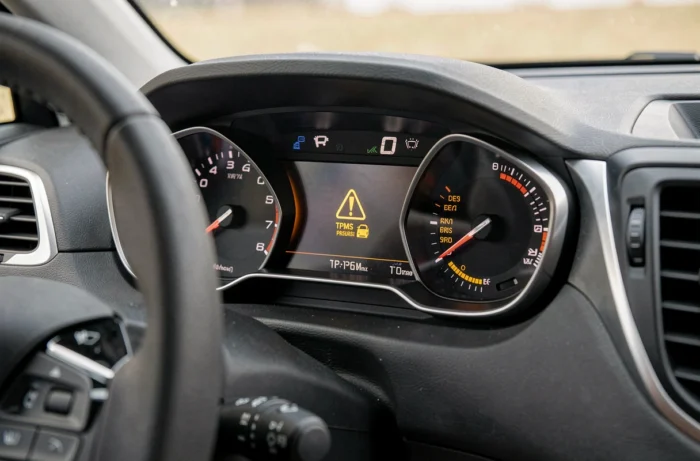
Tire pressure warning light persists after reset: diagnosing the real causes
A light that comes back on in the days following a correct reset indicates a mechanical problem, not a software bug.
- Slow puncture: an object in the tread (screw, nail) can cause a loss of a few tenths of a bar per week, enough to trigger the alert
- Damaged valve: rubber valves age and can leak at the seal, especially after a high-pressure wash
- TPMS sensor at the end of its life: the battery integrated into direct sensors has a limited lifespan (several years depending on usage) and is not rechargeable
- Cracked or corroded rim: a micro-crack on an alloy rim allows air to escape very slowly
To isolate the affected wheel, a precision gauge and daily monitoring over three to four days are sufficient. The wheel that loses pressure is the one that triggers the light. On a direct TPMS, some diagnostic tools display the individual pressure of each sensor and directly identify the faulty wheel.
Resetting the tire pressure warning light on a Peugeot 2008 remains a simple operation when the pressures are indeed correct and the TPMS system is functioning normally. When the light resists a well-executed reset, the real issue is no longer the reset but the physical condition of the tire, valve, or sensor.