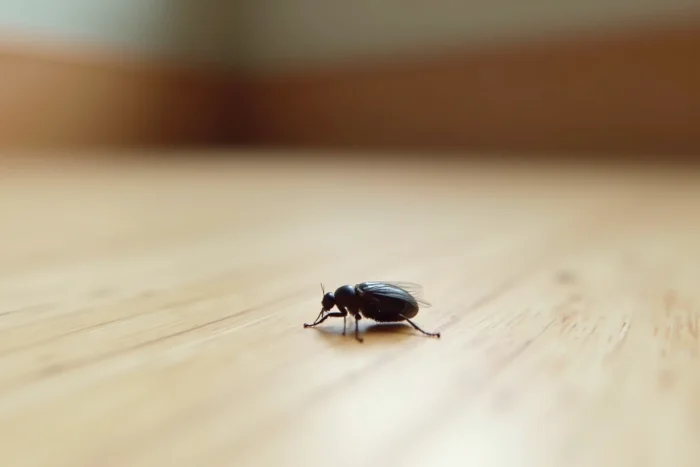
The majority of the small black jumping creatures observed indoors belong to two distinct groups: fleas (order Siphonaptera) and springtails (non-insect hexapods). Confusing the two is akin to addressing a humidity issue with an insecticide or ignoring a real parasitic infestation. Before any professional intervention, a reliable morphological and behavioral diagnosis helps avoid costly and inappropriate treatments.
Furca or hind legs: the jumping mechanism as the first sorting criterion
The way the organism jumps is the quickest and most reliable identification criterion. Springtails use an abdominal organ called a furca, folded under the body at rest, which suddenly relaxes to propel the animal. The jump is erratic, short, and the animal falls without precise orientation.
Fleas jump using their enlarged hind legs. The jump is more directional, higher in proportion to body size, and the flea often lands on a host or textile. Observing the jump with the naked eye already provides a usable indication of its trajectory.
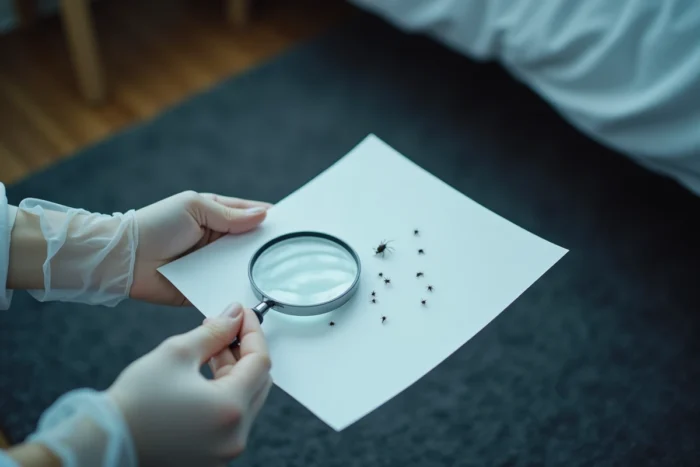
We recommend capturing a specimen with clear adhesive tape, sticky side down. This simple collection allows for observation with a magnifying glass or smartphone (macro mode) to distinguish morphology: laterally flattened body for the flea, globular or elongated body for the springtail. Size also helps: domestic springtails rarely exceed two millimeters, while adult fleas reach three to four millimeters.
To identify a small black jumping creature with certainty, this adhesive collection remains the most accessible method before contacting a pest control professional.

Fleas in the home: combined signals that confirm an infestation
Simply observing a jump is not enough to indicate a flea infestation. We regularly see interventions requested in error based on a single specimen spotted on the ground. To confirm the active presence of fleas, several signals must combine.
- Grouped bites, often in clusters of three or four, located on the lower legs, ankles, and feet, areas accessible from the ground or low textiles
- The presence of a host animal (cat, dog, rodent) in the home or in the immediate vicinity, as domestic fleas (Ctenocephalides felis, Ctenocephalides canis) depend on a host for their reproductive cycle
- Dark droppings in the fibers of the floor, baseboards, or textiles close to the ground, recognizable by their reddish-brown color when in contact with damp paper (the so-called “wet paper test”)
- A marked resurgence after a prolonged absence from the home, with fleas emerging massively from their pupal cocoon due to vibrations upon the return of the occupants
Without at least three of these simultaneous indicators, the flea diagnosis remains uncertain. A preventive treatment using diatomaceous earth on textile areas and baseboards can be implemented while awaiting confirmation.
Springtails and humidity: when the black creature signals a building problem
Springtails do not bite, do not parasitize humans, and do not damage materials. Their presence in large numbers in a home indicates localized excess humidity. We mainly find them in bathrooms, kitchens, basements, around plant pots, and in degraded tile joints.
Chemically treating springtails without correcting humidity does not solve anything. Populations return as soon as conditions become favorable again. The relevant approach is to identify the source of humidity: leaks, ventilation issues, rising damp, persistent condensation.
A hygrometer placed in the affected room for a few days can confirm the link. Beyond a consistently high relative humidity level, the problem is more related to a craftsman (plumber, ventilation specialist) than to an exterminator.
Frequent confusion with psocids
Psocids (booklice), sometimes called “book lice,” are another species that is black or grayish and very small, common in humid environments. They do not jump per se but move quickly in bursts, which can create the illusion of jumping. Their presence confirms the same diagnosis of excess humidity and does not require insecticide treatment.
When to call a pest control professional: concrete thresholds
Consulting a specialist is justified in specific situations. If the adhesive collection confirms the morphology of the flea and the infestation signals are present, a professional treatment combining adulticide and growth regulator remains the most effective method to break the larval cycle.
Another case justifying a call: the persistence of a population after two domestic treatments spaced a few weeks apart. The failure of a home treatment often signals an untouched larval nest, typically under floating floors, in thick carpeting, or in an animal’s den.
On the other hand, if the identification points to springtails, psocids, or thrips (tiny black insects sometimes found near windows in warm weather), the intervention of an exterminator is rarely justified. Correcting the humidity level or simply cleaning indoor plants is sufficient in the vast majority of cases.
The diagnosis by precise identification of the species before any spraying or fumigation remains the central recommendation of industry professionals. A specimen captured on adhesive, a few close-up photos, and a description of the capture location: these three elements provided to a technician allow for a reliable pre-diagnosis, often without a site visit. A well-targeted treatment costs less than a series of blind sprays.