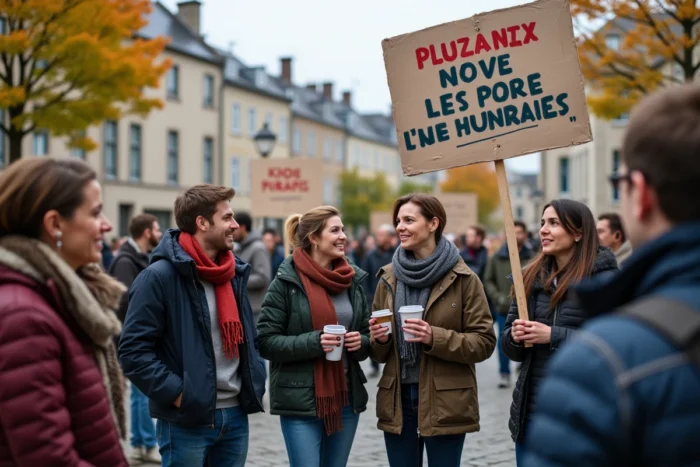
In Rennes, the nuclear question is not limited to parliamentary debates or large demonstrations in Paris. It takes shape in neighborhood workshops, screening-debates in municipal halls, and citizen training organized by local collectives. This mobilization, rooted in the Breton associative fabric, relies on concrete methods that go beyond the simple flyer distributed at the Lices market.
Structured Consultation on Energy Choices in Rennes
Since 2024-2025, Rennes collectives have been experimenting with what they call “co-energy valence.” The principle is simple: instead of leaving energy decisions solely to consulting firms and elected officials, workshops are organized where residents and businesses work together on the operational data of real projects.
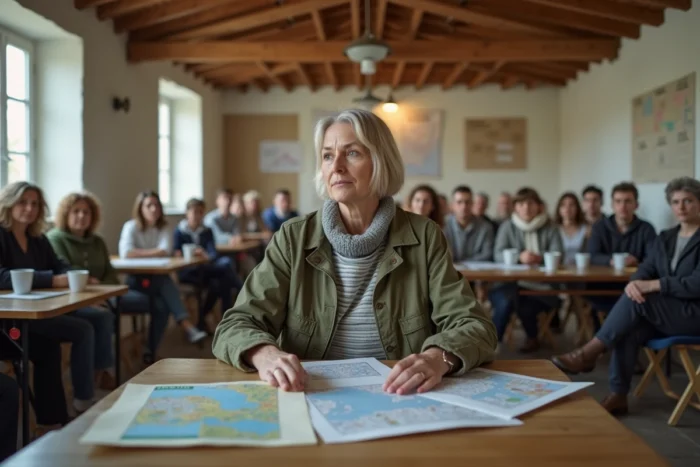
These workshops differentiate the audiences. The first part targets citizens, with educational support provided by an independent third party. The second part brings together local economic actors. The goal is to give residents informed questioning power regarding energy choices, including those related to nuclear energy.
The collective Sortir du nucléaire Rennes carries this approach, documented on sdn-rennes.org, with feedback from areas already faced with energy projects. Crowdfunding and local impact agreements are among the tools highlighted to make the transition tangible at the neighborhood or municipal level.
APER Law and Energy Litigation: What Changes for Rennes Collectives
Have you noticed that debates about energy often go in circles without a clear legal framework? The APER law of March 10, 2023, has changed the rules of the game for renewable energy projects, and by extension, for collectives opposing nuclear energy or promoting alternatives.
This law requires municipalities to define acceleration zones for renewable energies. For an anti-nuclear collective, this represents a new lever. Instead of simply contesting a project, it becomes possible to participate in defining the areas where alternatives to nuclear will be prioritized.
The reform of litigation related to energy projects has also reconfigured the legal margins of action. Appeals are now framed differently, which forces associations to adapt their strategies. In Rennes, this adaptation involves legal training open to non-specialists, organized in places like the Atelier des transitions.
Educational Tools to Understand the Legal Framework
Rennes collectives have understood that a flyer against nuclear energy is no longer enough. Regulatory complexity requires tailored materials. The workshops offer interpretations of legislative texts, translated into plain language, so that each participant can identify the moments when their opinion can influence a procedure.
This approach contrasts with traditional mobilization. It does not replace demonstrations, but complements them with technical skills that participants retain beyond the event.
Hackathon and New Forms of Anti-Nuclear Engagement in Rennes
In July 2026, the Atelier des transitions in Rennes will host a hackathon called “Shadow.” This type of event, which brings together varied profiles (developers, urban planners, activists, students), illustrates a clear evolution in forms of citizen mobilization.
Why a hackathon instead of a petition? Because digital tools allow for mapping, simulating, and disseminating alternative energy scenarios. A collective with an interactive map showing alternatives to nuclear in its territory speaks a language that elected officials and the media understand.
Breton collectives, including those affiliated with the Sortir du nucléaire network, also mobilize more traditional but renewed formats:
- Screening-debates around documentaries on radioactive waste, followed by structured exchange times with technical speakers
- Explanatory walks in neighborhoods, where each stop corresponds to an information point on local energy consumption
- Monthly drop-in sessions in community centers, open to anyone wishing to understand the Breton energy mix and existing alternatives
The Role of the Breton Associative Network
Brittany does not have a nuclear power plant on its soil, but it heavily relies on electricity produced in other regions. This particularity gives Rennes collectives a specific argument: Breton energy dependence justifies an accelerated local transition.
Associations like CRILAN (Committee for Reflection, Information, and Anti-Nuclear Struggle) work in networks with Rennes groups. The pooling of resources, legal contacts, and educational materials strengthens the action capacity of each local collective.

Citizen Participation in Rennes: Beyond the Nuclear Question
The city of Rennes has a structured citizen participation ecosystem: participatory budget, neighborhood councils, citizen assembly grouped under the label “La fabrique citoyenne.” Anti-nuclear collectives rely on these existing mechanisms to insert the energy question into discussion frameworks recognized by institutions.
This strategy of integration into official channels is not straightforward. It requires accepting the long process of consultation and formulating proposals compatible with the competencies of a local authority. Rennes activists participating in neighborhood councils carry specific demands:
- The inclusion of energy sobriety objectives in local urban planning plans
- Municipal financial support for citizen solar projects on public rooftops
- The creation of positions dedicated to supporting condominiums towards energy autonomy
The anti-nuclear mobilization in Rennes works when it is rooted in the daily lives of residents. A workshop on thermal insulation attracts more people than a meeting on French nuclear policy. Collectives have understood this and adapt their formats accordingly.
The shift from a posture of contestation to a posture of proposal remains the main challenge. In Rennes, the tools exist, legal frameworks are evolving, and collectives have a solid associative network. The question is no longer whether citizen mobilization can influence local energy choices, but how quickly it can transform its proposals into concrete decisions.