Your baby is sitting up, pushing on their legs, and starting to want to explore the living room. The walker, this wheeled seat also known as a baby walker, seems like a perfect solution. Before installing one in your home, a few practical checks are necessary to ensure this accessory remains an ally and not a source of danger.
Walker with seat and home layout: the true first criterion
Most guides compare models with each other. The preliminary question is simpler: is your home compatible with a walker?
By raising the baby and making them mobile, the seated walker gives them access to areas they wouldn’t otherwise reach. Handles of pots on the stove, cleaning products on a low shelf, table edges at face height: the walker shifts the child’s risk perimeter.
Door thresholds, thick carpets, and uneven floors also pose problems. A wrinkled rug or a small toy on the floor can block a wheel and tip the whole thing over. And even with a wider base or brakes, no integrated device completely neutralizes these domestic hazards.
You will find detailed sheets and model comparisons on youpala-bebe.fr, which allows you to check the dimensions before purchase. Measure the width of your doorways and the free space on the floor in the main room: if the walker doesn’t fit or if the baby doesn’t have at least a few square meters of clear space, the accessory will lose its appeal.
Stairs and adjoining rooms
The most documented risk remains falling down stairs. A home with steps not secured by a barrier is incompatible with a walker, regardless of the chosen model. If your house has levels, a safety gate is not an option; it’s a prerequisite.
Safety standard and points to check on the walker
Have you ever turned a walker over to look under the base? That’s where the most useful information is found.
The European standard EN 1273 regulates the manufacturing of walkers. It imposes requirements on stability, material strength, and the absence of pinch points. A compliant product bears this mention on its packaging or instructions.
Beyond the standard, three elements deserve direct inspection:
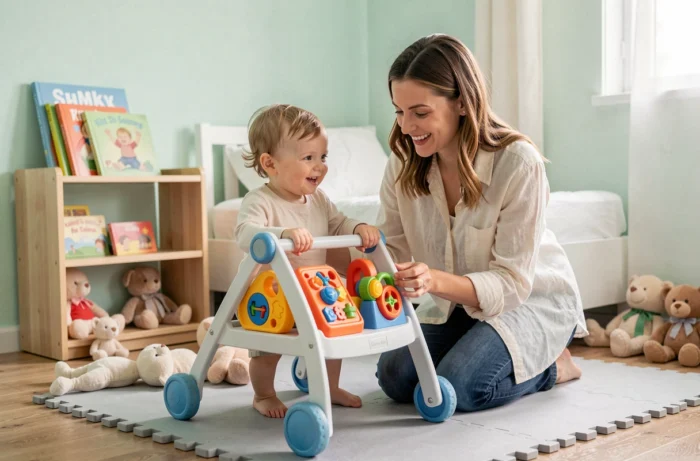
- The width of the circular base: the wider it is, the less likely the walker is to tip over when the baby gains speed or bumps into an obstacle.
- The height adjustment system: the child must be able to place their feet flat on the ground, without being on their toes. An inappropriate adjustment alters their posture and reduces their control.
- The seat and harness: the seat must hold the baby without compressing their thighs, and the backrest must properly support their back during rest phases.
Walker and walking development: what studies show
The walker bears its nickname “trotteur” poorly. No data shows that it accelerates the learning of walking. Some observations even suggest that prolonged use may slightly delay the acquisition of independent walking.
Why this paradox? The walker places the child in a standing position, but it’s the structure that ensures balance, not the baby. The trunk, hip, and ankle muscles, the very ones that allow standing and then walking, work less than during autonomous movement.
In practice, a baby who spends long periods in their walker primarily engages the pushing of their toes. This motor pattern differs from that of walking, where the foot rolls from heel to toe. Limiting sessions to short periods (a few minutes) allows for enjoyment of the playful aspect without interfering with motor development.
Alternatives to the walker based on your child’s age and needs
If after consideration the seated walker does not suit your home or your approach, several options exist. They do not all serve the same purpose.
The push walker (walking cart)
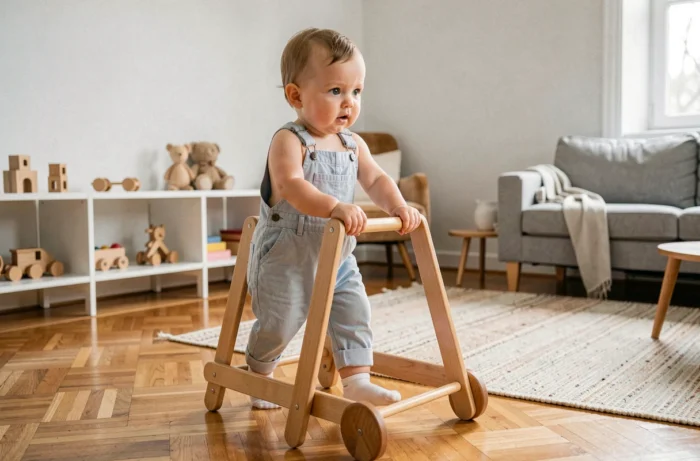
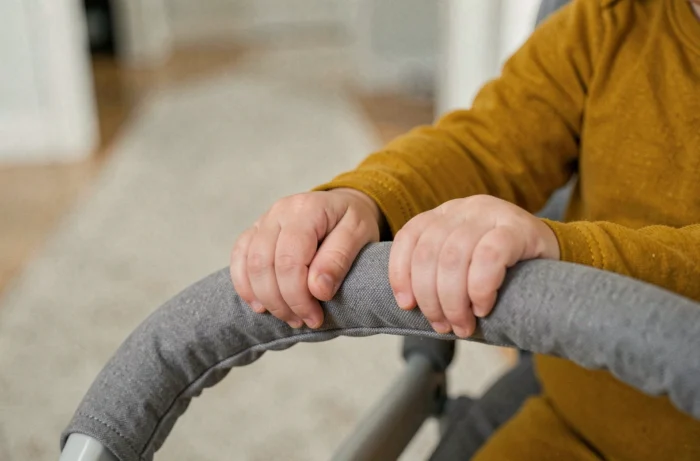
The push walker works in the opposite way to the seated walker: the child stands, grips a bar with both hands, and moves forward themselves. Their balance is constantly engaged. A wooden walking cart, weighted with blocks or toys, provides natural resistance that prevents the push walker from sliding too quickly on tile.
The push walker is suitable when the baby can already stand for a few seconds while holding onto a piece of furniture. Before this stage, they risk collapsing forward.
The fixed activity center
An activity center without wheels offers the vertical position and stimulation of the walker, without mobility. The baby can turn around, manipulate toys, but does not move around the room. For small spaces or risky homes, this is often the most suitable compromise.
Floor play and furniture
Pulling themselves up along a sofa, cruising along a coffee table, getting back up after a fall on a rug: these daily actions build balance better than a device. A secure environment on the floor remains, according to many pediatricians’ recommendations, the best preparation for first steps.
The choice of the right accessory depends as much on your child as on your home. A well-chosen walker, used in short sessions in a clear and secure space, can support the baby’s awakening. If the conditions are not met, a push walker or simply a well-arranged living room will do just as well.