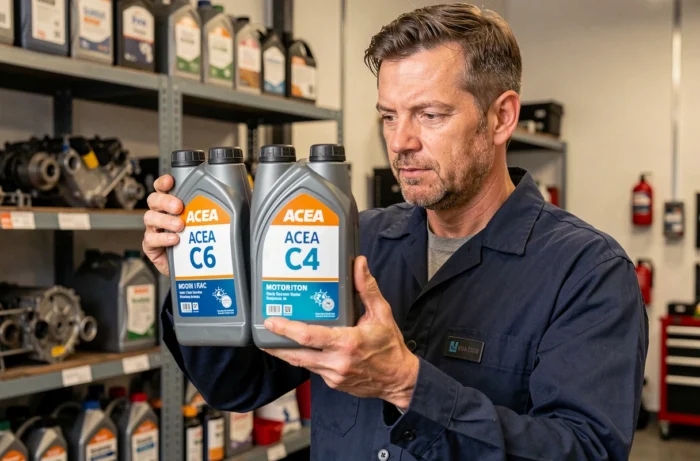
Your maintenance booklet indicates an ACEA C4 oil, but the can available at your garage shows ACEA C3. The temptation to make do with what you have on hand is strong. However, behind these two letters followed by a number lie different formulations designed to protect distinct engine components. Understanding what separates ACEA C3 oil from C4 helps avoid costly damage to the particulate filter or the engine itself.
SAPS Content: The Criterion That Really Separates C3 and C4
Most guides describe C3 and C4 oils as “suitable for diesel engines with DPF.” This is true, but too vague to make an informed choice. The real dividing line between these two categories has a technical name: the SAPS level.
SAPS stands for Sulphated Ash, Phosphorus, Sulphur. These elements come from the oil additives. When the oil partially burns in the combustion chamber, these additives leave solid residues that accumulate in the particulate filter.
An oil ACEA C3 is classified mid-SAPS: its content of ash, phosphorus, and sulfur is moderate. It offers a good compromise between engine protection and DPF preservation. An oil ACEA C4 is classified low-SAPS: its content of these same elements is significantly lower.
Why does this distinction matter in everyday use? Because less ash means less clogging of the particulate filter, but also fewer anti-wear additives available to protect the internal engine parts. It’s a trade-off, not a simple ranking from “best to least good.”
If you’re looking to delve deeper into the compatibility of ACEA C3 and C4 oils, be aware that mixing these two categories is not trivial and depends on the engine in question.
ACEA C4 Oil and Renault Diesel Engines: A Manufacturer Requirement, Not a Luxury
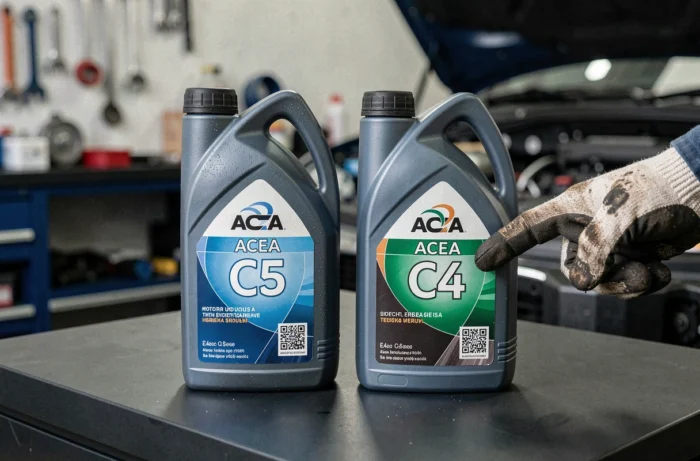
You may have noticed that Renault systematically prescribes ACEA C4 oil (often in 5W-30 viscosity) for its diesel engines equipped with a DPF. This is not a commercial whim.
Renault diesel engines (notably the dCi blocks) use exhaust gas after-treatment systems that are particularly sensitive to ash residue. A mid-SAPS C3 oil, even of good quality, generates more deposits in the particulate filter of these engines.
The documented case on forums is telling: a 2012 Renault Trafic diesel DPF received C3 oil instead of the prescribed C4 during an oil change at a service center. Less than a month later, the owner noticed a DPF alarm, an oil alarm, and an injector problem. Disassembling the oil pan revealed an oil filter clogged with thick residue, accompanied by iron filings.
Using C3 oil in an engine that requires C4 accelerates DPF clogging and can lead to more frequent regenerations or even cascading failures. The reverse (putting C4 in an engine designed for C3) poses fewer risks for the filter, but the reduced anti-wear protection can affect the engine’s longevity in the long term.
Suffix “-23” on ACEA Oil Cans: What the Sequence Date Means
You may have seen mentions like “ACEA C3-23” or “ACEA C4-23” on some recent cans. This suffix is not decorative.
Since the ACEA Engine Oil Sequences 2023, each category carries a suffix that identifies the version of the tests and performance limits applied. Specifically:
- An oil labeled simply “ACEA C3” may still meet the requirements of 2016 or 2021, which are older versions of the specifications.
- An oil marked “ACEA C3-23” meets the revised testing procedures in 2023, with updated performance criteria.
- The 2021 sequence for light vehicle oils is officially considered obsolete since August 2025: a product that remains at the 2021 standard can no longer make new performance claims.
This point is rarely mentioned in consumer guides. During your next oil change, checking for the presence of the suffix “-23” on the can ensures you have an up-to-date formulation.
Reading the Label of a Can in Practice
Look for the mention ACEA followed by the letter and number (C3, C4, C5, etc.), then any potential suffix. If only “ACEA C3” appears without a suffix, the product may comply with an older sequence. This is not necessarily bad, but a can displaying the suffix “-23” offers a guarantee of compliance with the latest standards.

Practical Precautions Before Choosing Between C3 and C4 for Your Oil Change
The vehicle’s maintenance booklet remains the only reliable reference. Neither the seller in the store nor the viscosity listed on the can is sufficient to validate the choice. Here are the points to check before any oil change:
- Consult the manufacturer’s recommendation in the maintenance booklet or on the filler cap under the hood. It mentions the ACEA standard and sometimes a manufacturer-specific reference.
- Never substitute C3 oil for a prescribed C4, especially on Renault, PSA, or certain Mercedes diesel engines equipped with ash-sensitive DPFs.
- If your engine accepts C3, a C4 oil will work for the particulate filter, but the anti-wear protection will be slightly lower. On a high-mileage engine, this difference can matter.
- Prefer cans bearing the suffix “-23” to benefit from the latest ACEA performance requirements.
A one-time C3/C4 mix (top-up in an emergency) will not immediately destroy the engine. However, driving sustainably with the wrong ACEA category gradually degrades the DPF or the engine in a progressive and often irreversible manner.
The cost of a can of oil that complies with the manufacturer’s recommendation remains trivial compared to the cost of replacing a particulate filter or an engine overhaul. Checking the exact ACEA standard on the label takes thirty seconds, and it’s the most cost-effective action of the entire oil change.