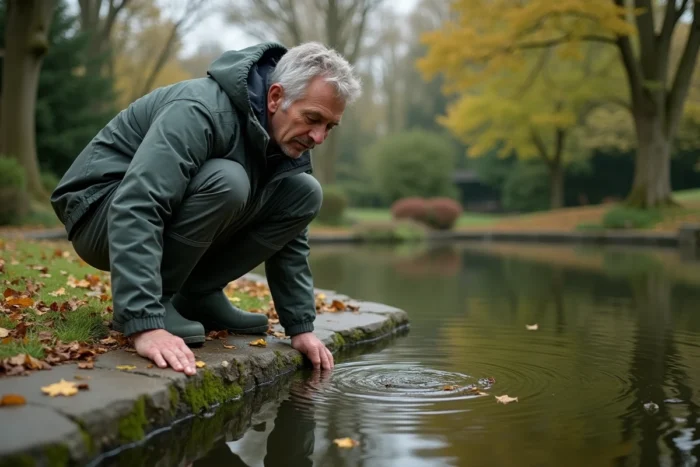
A pond for sale for several months, a price that seems attractive, a beautiful wooded setting. We sign, we move in as the owner, and three months later, the DDT sends a letter for non-compliance of the drainage structure. This scenario is not exceptional. Buying a pond comes with obligations that most buyers discover after signing, due to not having asked the right questions at the right time.
Check the water supply before looking at the surface
When visiting a pond, we often focus on the area and the landscape. The first question to ask concerns the water supply. A pond fed by a spring or a permanent stream does not have the same constraints as a body of water dependent on a groundwater table or rainwater runoff.
A spring-fed pond remains filled even in dry summers. A pond fed only by rain can drop several tens of centimeters between June and September, with direct consequences on fish life and siltation. We have seen bodies of water lose a significant portion of their volume over several consecutive summers of drought.
To fully understand these issues, there are tips before buying a pond that detail the checks to be made on-site. The mode of supply also conditions the quality of the water: runoff from agricultural sources can carry nitrates and phosphates, promoting eutrophication.
Ask for the supply flow rate and its source before any discussion about the price. If the seller cannot answer, it is a warning sign.
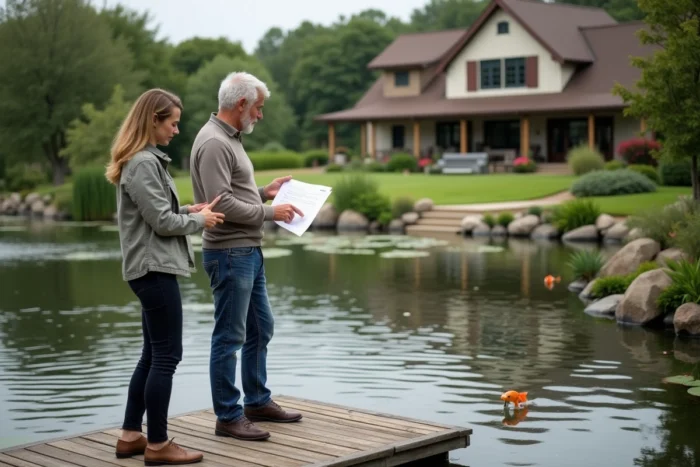
Closed water or free water: the legal status that changes everything
The status of the body of water determines what you are allowed to do with it. The distinction between closed water and free water is not just an administrative nuance.
Closed water pond
A pond is classified as closed water when fish cannot move freely between the body of water and a watercourse. Specifically, there must be grids, elevations, or a complete lack of connection preventing the fish from moving up or down.
In closed water, the owner has unrestricted fishing rights: no fishing license, no adherence to opening periods, total freedom regarding introduced species (within health regulations). This is the most sought-after status for private recreational use.
Free water pond
As soon as a fish can technically move between the pond and a hydrographic network, the body of water falls under free water regulations. A fishing license becomes mandatory, opening periods apply, and the fishing federation may have oversight rights.
The common trap: a pond sold as “private” may very well fall under free water if the downstream grid is broken or missing. Physically check the condition of the separation structures during the visit. A simple overflow pipe without a grid is enough to reclassify the status.
Compliance of structures and drainage obligations
Most ponds have a drainage structure (sluice, bottom drain, valve). This device is not optional: it is regulated by water police. The pond must be able to be drained in a controlled manner, with a discharge that meets quality thresholds downstream.
Before buying, check three concrete points:
- The sluice or bottom drain works and is not clogged with silt. A structure blocked for years may require heavy intervention, with costs that surprise unsuspecting buyers.
- The flood spillway (the overflow) is sized to handle heavy rain episodes without causing erosion downstream. An undersized spillway makes the owner liable in case of damage to a neighbor.
- The last drainage was carried out within a reasonable timeframe. A pond that has never been drained accumulates organic silt that reduces usable depth and degrades water quality. Dredging represents a significant budget.
Request the receipt of the declaration of existence from the seller. This document proves that the body of water is known to the administration. Without it, there is a risk of a formal notice to restore the site, meaning the destruction of the dam.
Preemption rights and local water policy: recent developments
When selling a pond, the SAFER (Land Development and Rural Establishment Company) can exercise a preemption right. The Conservatory of Natural Spaces may also intervene if the site has ecological interest. These preemptions extend timelines and can derail a transaction.
Another element to watch: the law of April 11, 2025, on water management and sanitation has given more flexibility to municipalities in organizing their water services. Implementation decrees published in February 2026 now allow communities to revise their water resource management and discharge policies. Specifically, a municipality can strengthen its requirements on private bodies of water (controls, compliance, drainage restrictions).
Before signing, contact the town hall to know the zoning of the land (wetland, Natura 2000, ZNIEFF) and any local constraints regarding water management. Responses vary on this point: some municipalities apply a strict policy, others are less stringent, but the trend is clearly towards reinforcement.
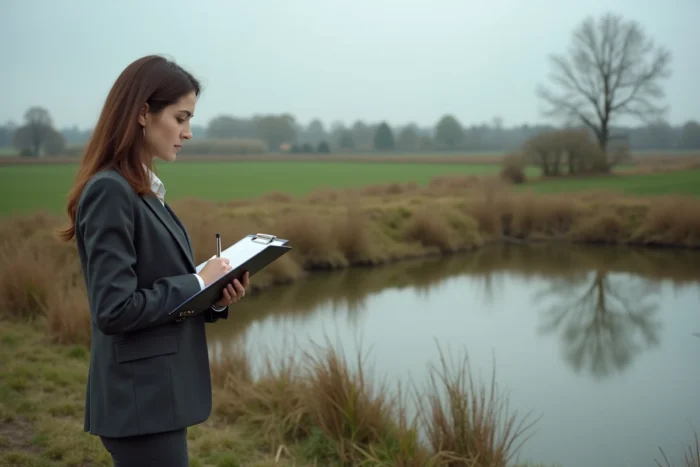
Siltation and water quality: what you can’t see beneath the surface
A pond can look beautiful on the surface and hide a bottom covered with a meter of silt. Siltation is the number one problem for poorly maintained bodies of water. It reduces depth, promotes algae proliferation, and degrades fish living conditions.
During the visit, a few telltale signs include:
- A strong smell of silt, especially in warm weather, indicates a significant layer of organic matter decomposing.
- Sunken or eroded banks indicate long-term maintenance issues.
- A massive presence of water lilies on the surface indicates an excess of nutrients, often linked to agricultural runoff or a lack of drainage.
- A visible bottom only in the first few centimeters from the shore, followed by total opacity, suggests advanced siltation.
Request the date and report of the last drainage to get a reliable idea of the actual state of the bottom. If no drainage has been done for over ten years, expect costly dredging, which should be factored into the acquisition budget.
Buying a pond remains a land investment where physical visits, administrative documents, and dialogue with the town hall matter more than the photos in the listing. A compliant, well-fed, and regularly maintained body of water retains its value. A pond without paperwork, silted, and poorly connected to the hydrographic network can become a burden that is difficult to resell.