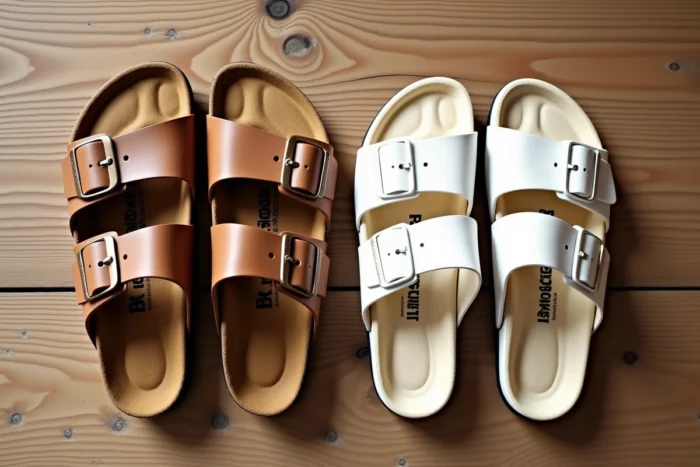
The Birkenstock cork-latex sole and the Scholl injected foam sole do not share the same biomechanical specifications or industrial logic. Understanding what separates these two approaches requires going beyond simple marketing comparisons to examine the design, materials, and actual lifespan of the products.
Cork-latex sole versus injected foam: how the technical choice makes a difference
Birkenstock builds its sole around a core of natural cork mixed with latex, topped with a suede lining. This composite gradually deforms under the weight of the wearer to conform to the foot’s footprint. The initial rigidity, often criticized in the first few days, precisely reflects this ability of cork to mold without collapsing.
Scholl favors soles made of injected polyurethane or EVA foam, sometimes combined with a gel layer. The comfort is immediate, almost “plug and play.” The foot sinks in with the first step, which appeals to wearers who refuse any break-in period.
We observe that this difference in philosophy has direct consequences on arch support. The cork-latex maintains a firm curve that supports the foot’s natural pronation. The injected foam absorbs shocks more but offers more limited lateral support, especially after several months of use when the foam begins to compress. To delve deeper into the differences between Scholl and Birkenstock, the construction of the sole remains the most reliable distinguishing criterion.

Repairability of Birkenstock and Scholl sandals: an underestimated criterion
Birkenstock allows for the replacement of soles and straps on several of its models through a network of authorized cobblers. This possibility of resoling significantly extends the lifespan of a pair, sometimes by several additional years. The cork can be refreshed, the insole can be replaced, and the structure remains functional as long as the shell is not cracked.
At Scholl, most recent models use monobloc injected soles. This process simplifies manufacturing and reduces costs but makes repair nearly impossible. When the sole wears out, the entire sandal must be replaced. For a daily wearer, this means a shorter renewal cycle.
This parameter also weighs on the environmental front. A sandal that can be repaired two or three times generates mechanically less waste than a model that is discarded after a season or two. Wearers concerned about their ecological footprint should consider this criterion in their decision-making.
Width, fit, and foot morphology: adapting the model to the wearer
Birkenstock historically offers two widths per model: regular (standard to wide foot) and narrow (slim foot). This segmentation allows for precise adjustment, especially on models like Arizona or Boston where width affects the support of the straps.
Scholl generally adopts a single fit per size, calibrated to an average width. For wide feet or pronounced hallux valgus, the choice is limited to a few references. Conversely, slim feet often find satisfaction in Scholl mules and clogs, whose more enveloping shape compensates for the lack of width adjustment.
- Wide or strong feet: Birkenstock in regular width, with adjustable buckle straps
- Thin or narrow feet: Birkenstock in narrow width, or Scholl mules with a fitted design
- Wearers needing immediate cushioning (prolonged standing): Scholl with gel or high-density foam sole
- Wearers seeking durable structural support: Birkenstock in cork-latex, after break-in
Scholl and Birkenstock sandals: price positioning and product range logic
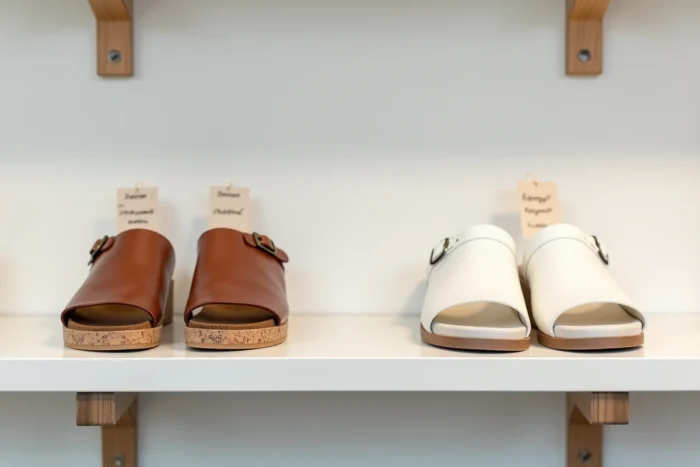
The two brands do not target the same price segment. Classic Birkenstock sandals (Arizona, Gizeh, Madrid) are positioned in a higher range, justified by manufacturing in Germany and natural materials. The initial premium is partially offset by the durability and repairability of the product.
Scholl offers a more accessible entry-level range, with models made from synthetic materials produced in various factories worldwide. The brand complements its offering with fashion collections (collaborations, trendy clogs) that increase in price but remain generally below the comparable positioning of Birkenstock.
Fashion collection or healthcare shoe: two brand identities
Scholl oscillates between its medical heritage (orthopedic insoles, podiatric care) and a recent desire to appeal to the fashion market. This dual identity sometimes muddles the message, as a Scholl clog sold as a trendy accessory does not necessarily provide the same support as a model designed for therapeutic use.
Birkenstock has resolved this tension differently. The brand has kept its historical models nearly unchanged while accepting occasional collaborations (designers, luxury brands) that reposition the product without altering its technical construction. The biomechanical base remains the same; only the exterior changes.
Ultimately, the choice between these two brands depends on what the wearer expects from their sandal. Immediate cushioning, a contained price, and a variety of styles lead towards Scholl. Long-term structural support, tangible repairability, and a fit adaptable to foot morphology point towards Birkenstock. Neither option is universally superior, but they do not meet the same priorities.