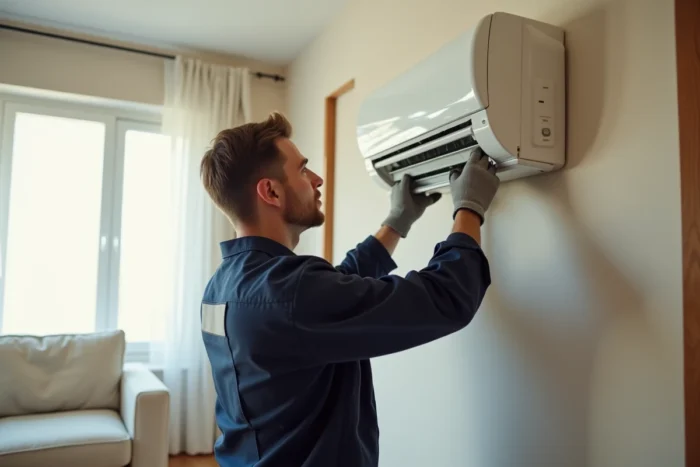
The sizing of a split air conditioning system is not just a simple rule of three based on the living area. Before choosing a model or contacting an installer, several technical parameters affect the long-term performance of the system, and most consumer guides gloss over them.
Thermal assessment before quote: the calculation that catalogs don’t do for you
A wall-mounted split with the same cooling power will not provide the same comfort in two rooms of identical size. The orientation of the windows, the level of wall insulation, the ceiling height, and internal loads (appliances, occupants, lighting) radically change the actual thermal load.
We recommend conducting a room-by-room thermal assessment before requesting any quotes. This calculation, usually performed during the preliminary technical visit, includes heat losses, solar gains by facade, and air renewal. Without this assessment, the risks are twofold: an undersized system that runs continuously without reaching the setpoint, or an oversized system that cycles too often, increasing compressor wear and degrading indoor humidity levels.
The preliminary technical visit, now offered as a formal step in the installation process by reputable installers, also covers facade constraints, regulatory distances from neighbors, and usage scenarios (remote work, nighttime occupancy). Before comparing quotes, each contractor must start from the same assessment. This is the only way to obtain comparable proposals.
Division of work between the homeowner and certified refrigeration technician
In recent years, the boundary between what a homeowner can prepare themselves and what must be done by a certified professional has become clearer. Several players in energy renovation are now explicitly formalizing this division of tasks.
Before installing air conditioning at home, you can anticipate a significant part of the work to reduce the technician’s intervention time (and thus the cost).
Tasks that can be done by the homeowner:
- Preparation of the dedicated electrical circuit (suitable circuit breaker, compliant cable size) up to the connection point planned for the outdoor unit
- Fixing the indoor wall mount and the outdoor floor or wall mount, after validation of the location by the professional
- Drilling the wall for the passage of refrigerant lines and the condensate duct
- Setting up the condensate drainage path to a drainage point (inspection chamber, rainwater downpipe)
Tasks reserved for the refrigeration technician holding a certificate for handling refrigerants:
- Connecting the refrigerant lines between the indoor and outdoor units
- Vacuuming the circuit (mandatory to eliminate moisture and non-condensables)
- Pressure leak testing with nitrogen before opening the valves
- Opening the service valves and commissioning the system
- Checking operating parameters (high/low pressures, superheat, subcooling)
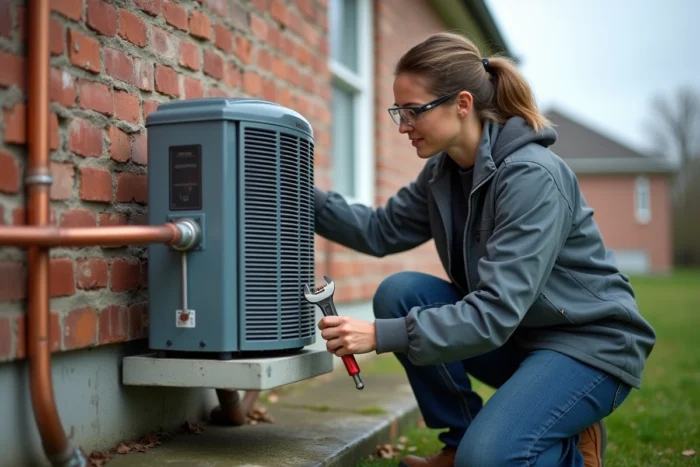
This division is not just a matter of regulation. The vacuuming and leak testing condition the lifespan of the compressor. A poorly purged circuit leads to accelerated degradation of the refrigerant oil and performance.
Pre-charged kits with sealed connections: what this changes practically
The so-called “ready-to-install” kits with pre-charged and sealed refrigerant connections (like ReadyClim or equivalents) have changed the game for homeowners. The principle: the copper tubes are delivered pre-filled with refrigerant, sealed by caps that are pierced when the fittings are tightened. No vacuuming, no refrigerant charging, no nitrogen bottle.
The absence of refrigerant handling does not eliminate regulation. The refrigerant is already in the circuit, but the installer remains responsible for the tightness of the connections. In practice, a homeowner can install this type of kit without a capacity certificate, provided they never open the refrigerant circuit after commissioning.
The limitation of these kits concerns the connection length. Pre-charged models impose a fixed distance between units (generally three to five meters). If the housing configuration requires a longer path, a standard kit with the intervention of a refrigeration technician remains the only reliable option.
Electrical connection and condensate drainage: two frequent points of failure
The electrical connection of a split is not just a simple plug into an existing outlet. Each outdoor unit requires a dedicated line protected by a suitable circuit breaker for the nominal current of the compressor, with an appropriate sensitivity differential. Connecting a split to a shared circuit with other devices exposes it to nuisance tripping and, in the worst case, cable overheating.
Condensate drainage is the second weak point of poorly prepared installations. The indoor unit produces several liters of water per day during summer operation. If the slope of the duct is insufficient or if the connection to the drainage point is not tight, water stagnates in the tray, generates odors, and eventually overflows into the false ceiling or along the wall.
We regularly observe installations where the condensate is simply directed outside via a pipe passing through the wall, without a siphon or connection to the wastewater network. This solution works, but it creates an entry point for insects and drafts. A dry siphon on the condensate line eliminates these two problems for a negligible cost.
Reversible air conditioning and air-to-air heat pump label: implications for system choice
A reversible air conditioning system is technically an air-to-air heat pump. This dual function (cooling in summer, heating in mid-season) influences sizing. A system optimized for cooling alone will not have the same coefficient of performance in heating mode, and vice versa.
If the system is to serve as supplementary heating in winter, the thermal assessment must include heating needs at the low outdoor temperatures of your climate zone. An air-to-air heat pump loses efficiency when the outdoor temperature drops below five degrees. In regions with harsh winters, relying on a reversible split as the main heating source amounts to undersizing the system for half the year.
The choice between a single split and a multi-split depends less on the number of rooms than on the simultaneity of use. Two bedrooms occupied only at night can share an outdoor unit without loss of comfort, while a living room and an office used simultaneously during the day will require the compressor to run at full load for long periods. This parameter alters the choice of the outdoor unit’s power, often overlooked in favor of simply counting rooms.