
You wake up to find aligned bites on your arms and small black spots on the mattress. The diagnosis is in: bedbugs. After the shock, a question quickly arises: will your home insurance cover the treatment? The short answer is often disappointing, but it deserves to be understood in detail to know exactly where to seek financial help.
Why multi-risk home insurance contracts exclude bedbugs
A standard home insurance policy, known as multi-risk home insurance (MRH), covers incidents considered random and sudden. Water damage, a fire, a storm: these events are unpredictable. Insurers categorize pest infestations differently.
For them, the presence of bedbugs falls under a lack of maintenance of the property, not an incident. The reasoning is simple: the infestation develops gradually, it can be prevented or treated early. This classification effectively excludes any coverage under standard guarantees.
In practical terms, if you report an infestation to your insurer without a specific option in your contract, the response will be a refusal. This applies to major traditional insurers as well as most online contracts. To better understand the mechanisms of home insurance in the face of bedbugs, it is essential to distinguish the basic contract from the options added at subscription.

Pest coverage option: what these contracts really cover
In recent years, some new insurers and specialized insurers have offered an optional “pest” coverage. This coverage exists, but it is very regulated. Before subscribing, three parameters deserve your attention.
The waiting period blocks immediate claims
You cannot subscribe to pest coverage after spotting the first signs of infestation. A waiting period systematically applies, often set at two months after the subscription date. If you report an infestation during this period, the insurer will refuse coverage.
This mechanism exists to prevent opportunistic subscriptions. It requires anticipation: the coverage is taken when everything is fine, not when the problem is already present.
A reimbursement cap that is often modest
Contracts that include a bedbug option set a reimbursement cap. Some student insurers, for example, limit coverage to 500 euros for the intervention of a certified professional. However, a complete treatment often requires two visits, and the total bill regularly exceeds this amount.
The cap rarely covers the entire cost of professional treatment. Also check if the contract limits activation to only once during the entire membership period. Some plans allow only one claim, which poses a problem in case of reinfestation.
Activation conditions to read before signing
To trigger the coverage, the insurer generally requires:
- A diagnosis performed by a certified professional (not just a personal observation)
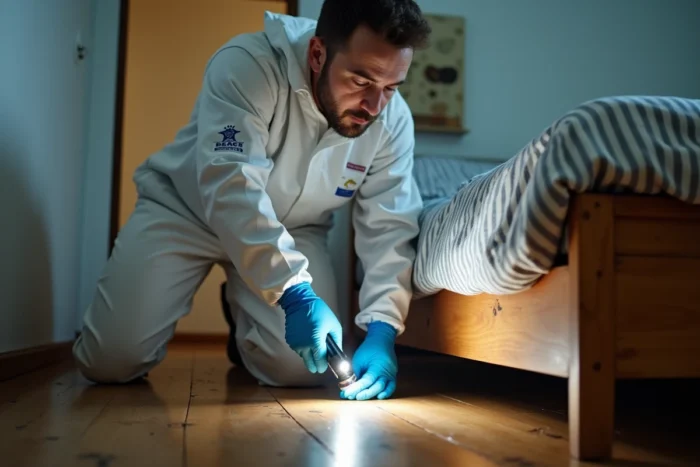
- The intervention of an approved pest control company, chosen according to the contract’s criteria
- A declaration within a specific timeframe after discovering the infestation
- Proof that the property is a primary residence (some plans exclude secondary residences)
Ignoring even one of these conditions is enough to void the reimbursement.
Bedbugs in rental properties: the ELAN law and cost distribution
Are you a tenant and have discovered an infestation? The question of payment does not solely depend on your insurance. The ELAN law has clarified the respective obligations of the landlord and the tenant.
The landlord must provide decent housing, free of pests, at the time of handing over the keys. If bedbugs are present from the moment you move in, the treatment is the landlord’s responsibility. However, if the infestation occurs during the lease and no defect in the property is to blame, the burden may fall on the tenant.
In practice, the situation is often contentious. The date of the bedbug appearance is difficult to prove. A very detailed entry inventory, noting the absence of pest traces, serves as useful protection for the tenant.
What the landlord cannot refuse
Even if the infestation seems linked to the tenant’s use, the landlord is still obliged to act if the property becomes uninhabitable. A landlord who refuses any intervention exposes themselves to legal action. The tenant can approach the departmental conciliation commission or the judicial court.
The landlord cannot simply invoke the tenant’s responsibility without having verified the condition of the property. The obligation of decency takes precedence.
Financial alternatives when insurance covers nothing
The majority of people facing bedbugs do not have pest coverage. Several options exist to limit the financial burden.
- Some local authorities and certain departments partially fund pest control interventions for low-income households
- The CAF may, in some cases, grant a one-time aid for housing improvement
- Requesting multiple quotes from certified companies allows for comparing prices, which vary significantly based on the size of the property and the number of necessary visits
Acting quickly also reduces the bill. An infestation treated at the first signs costs significantly less than treatment for a fully infested property. Regularly inspecting bedding and baseboards remains the most economical reflex.
The natural reflex when facing bedbugs is to seek reimbursement from your insurance. In most cases, the standard contract provides nothing. Optional guarantees exist but remain limited by caps, waiting periods, and strict conditions. Checking the clauses of your contract before any infestation, and knowing your rights as a tenant or owner, remains the best concrete protection.